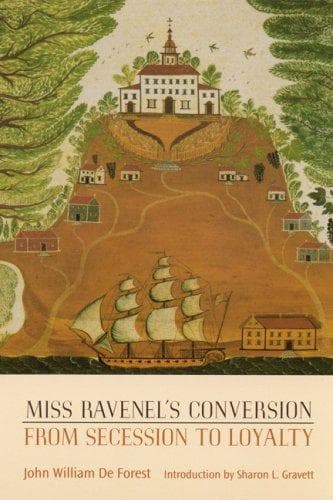
Miss Ravenel's conversion from secession to loyaltyDe Forest, John William
History
Miss Ravenel's conversion from secession to loyalty
De Forest, John William
Historical fiction; United States -- History -- Civil War, 1861-1865 -- Fiction; War stories; Women -- United States -- Fiction
"My dear," says the Doctor with emphasis, "I would rather be a private
soldier under the flag of my country, than be a major-general in the
army of those villainous conspirators against country, liberty and
humanity. I respect Colonel Carter for holding fast to his patriotic
sentiments, in spite of unjust neglect, far more than I would if he were
loyal merely because he was sure of being commander-in-chief."
Lillie could not fail to be gratified by such a compliment to the moral
worth of her hero. After a few moments of agreeable meditation on the
various perfections of that great being, she resumed the old subject.
"I think that there is a chance yet of his getting a star when the
official report of the battle of Georgia Landing once reaches the minds
of those slow creatures at Washington. What do you think, papa? What are
the probabilities?"
"Really, my dear, you perplex me. Prophecy never formed a part of my
education. There are even a few events in the past that I am not
intimately acquainted with."
"Then you shouldn't look so awfully old, papa. If you _will_ wrinkle up
your forehead in that venerable way, as if you were the Wandering Jew,
you must expect to have people ask you all sorts of questions. Why will
you do it? I hate to see you making yourself so aggravatingly ancient
when nature does her best to keep you young."
About these times the Doctor wrote, with a pitying if not a sad heart,
to inform Colburne of the engagement. The young man had looked for some
such news, but it nevertheless pained him beyond his anticipations. No
mental preparation, no melancholy certainty of forecast, ever quite fits
us to meet the avalanche of a great calamity. No matter, for instance,
how long we have watched the sure invasion of disease upon the life of a
dear friend or relative, we are always astonished with a mighty shock
when the last feeble breath leaves the wasted body. Colburne had long
sat gloomily by the bedside of his dying hope, but when it expired
outright he was seemingly none the less full of anguished amazement.
"Who would have thought it!" he repeated to himself. "How could she
choose such a husband, so old, so worldly, so immoral? God help her and
watch over her. The love of such a man is a calamity. The tender mercies
of the wicked are unintentional cruelties."
Public-domain text, read in full here on John Shaqi.
Reviews
Reviews
No reviews yet
Be the first to share your thoughts on this work.
Elsewhere in the archive
Join the Discussion
Join the discussion
Sign in to leave a comment or review.
Sign InorCreate an account