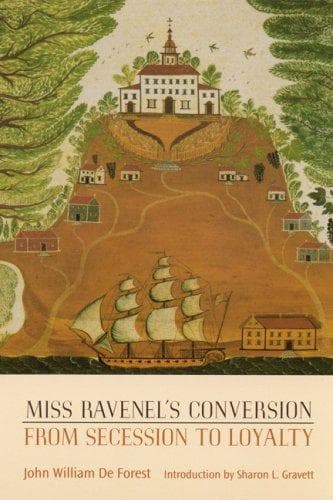
Miss Ravenel's conversion from secession to loyaltyDe Forest, John William
History
Miss Ravenel's conversion from secession to loyalty
De Forest, John William
Historical fiction; United States -- History -- Civil War, 1861-1865 -- Fiction; War stories; Women -- United States -- Fiction
In a general way one is tempted to speak jestingly of the circumstance
of a well-matured man falling in love with a girl in her teens. By the
time a man gets to be near forty, his moral physiognomy is supposed to
be so pock-marked with bygone amours as to be in a measure ludicrous, or
at least devoid of dignity in its tenderness. But Carter's emotional
nature was so emphatic and volcanic, so capable of bringing a drama of
the affections to a tragic issue, that I feel no disposition to laugh
over his affair with Miss Ravenel, although it was by no means his
first, nor perhaps his twentieth. Considering the passions as forces, we
are obliged to respect them in proportion to their power rather than
their direction. And in this case the direction was not bad, nor
foolish, but good, and highly creditable to Carter; for Miss Ravenel,
though as yet barely adolescent, was a finer woman in brain and heart
than he had ever loved before; also he loved her better than he had ever
before loved any woman.
He could not stay away from her. As soon as he had got his brigade into
such order as partially satisfied his stern professional conscience, he
obtained a leave of absence for seven days, and went to New Orleans.
From this visit resulted one of the most important events that will be
recorded in the present history. I shall hurry over the particulars,
because to me the circumstance is not an agreeable one. Having from my
first acquaintance with Miss Ravenel entertained a fondness for her, I
never could fancy this match of hers with such a dubious person as
Colonel Carter, who is quite capable of making her very unhappy. I
always agreed with her father in preferring Colburne, whose character,
although only half developed in consequence of youth, modesty, and
Puritan education, is nevertheless one of those germs which promise much
beauty and usefulness. But Miss Ravenel, more emotional than reflective,
was fated to love Carter rather than Colburne. To her, and probably to
most women, there was something powerfully magnetic in the ardent nature
which found its physical expression in that robust frame, that florid
brunette complexion, those mighty mustachios, and darkly burning eyes.
Public-domain text, read in full here on John Shaqi.
Reviews
Reviews
No reviews yet
Be the first to share your thoughts on this work.
Elsewhere in the archive
Join the Discussion
Join the discussion
Sign in to leave a comment or review.
Sign InorCreate an account