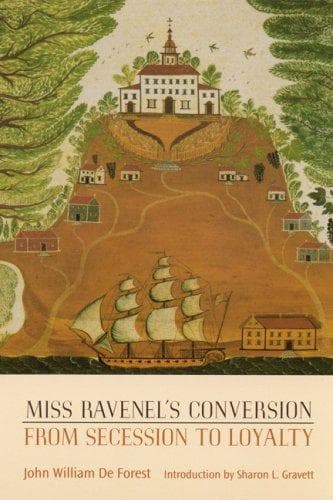
Miss Ravenel's conversion from secession to loyaltyDe Forest, John William
History
Miss Ravenel's conversion from secession to loyalty
De Forest, John William
Historical fiction; United States -- History -- Civil War, 1861-1865 -- Fiction; War stories; Women -- United States -- Fiction
The consequence of this visit to New Orleans was a sudden marriage. The
tropical blood in the Colonel's veins drove him to demand it, and the
electric potency of his presence forced Miss Ravenel to concede it. When
he held both her hands in his, and, looking with passionate importunity
into her eyes, begged her not to let him go again into the flame of
battle without the consolation of feeling that she was altogether and
for ever his, she could only lay her head on his shoulder, gently
sobbing in speechless acquiescence. How many such marriages took place
during the war, sweet flowers of affection springing out of the mighty
carnage! How many fond girls forgot their womanly preference for long
engagements, slow preparations of much shopping and needle-work, coy
hesitations, and gentle maidenly tyrannies, to fling themselves into the
arms of lovers who longed to be husbands before they went forth to die!
How many young men in uniform left behind them weeping brides to whom
they were doomed never to return!
"Brave boys are all, gone at their country's call,
And yet, and yet,
We cannot forget
That many brave boys must fall."
This sad little snatch from the chorus of a common-place song Lillie
often repeated to herself, with tears in her eyes, when Carter was at
the front, without minding a bit the fact that her "brave boy" was
thirty-six years old.
The marriage cost the Doctor a violent pang; but he consented to it,
overborne by the passion of the period. There was no time to be lost on
bridal dresses, any more than in bridal tours. The ceremony was
performed in church by a regimental chaplain, in presence of the father,
Mrs. Larue, and half a dozen chance spectators, only two days before the
Colonel's leave of absence expired. Neither then nor afterward could
Lillie realize this day and hour, through which she walked and spoke as
if in a state of somnambulism, so stupefied or benumbed was she by the
strength of her emotions. The lookers-on observed no sign of feeling
about her, except that her face was as pale and apparently as cold as
alabaster. She behaved with an appearance of perfect self-possession;
she spoke the ordained words at the right moment and in a clear
voice--and yet all the while she was not sure that she was in her right
mind. It was a frozen delirium of feeling, ice without and fire within,
like a volcano of the realms of the pole.
Public-domain text, read in full here on John Shaqi.
Reviews
Reviews
No reviews yet
Be the first to share your thoughts on this work.
Elsewhere in the archive
Join the Discussion
Join the discussion
Sign in to leave a comment or review.
Sign InorCreate an account