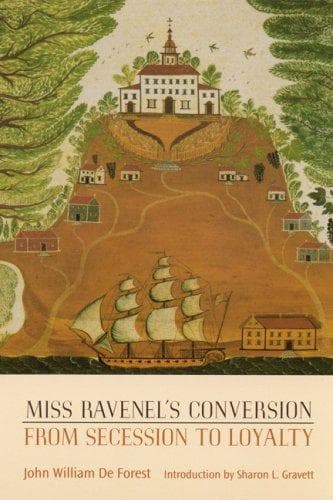
Miss Ravenel's conversion from secession to loyaltyDe Forest, John William
History
Miss Ravenel's conversion from secession to loyalty
De Forest, John William
Historical fiction; United States -- History -- Civil War, 1861-1865 -- Fiction; War stories; Women -- United States -- Fiction
Once in the hackney-coach which conveyed them home, alone with this man
who was now her husband, her master, the ice melted a little, and she
could weep silently upon his shoulder. She was not wretched; neither
could she distinctly feel that she was happy; if this was happiness,
then there could be a joy which was no release from pain. She had no
doubts about her future, such as even yet troubled her father, and set
him pacing by the half-hour together up and down his study. This man by
her side, this strong and loving husband, would always make her happy.
She did not doubt his goodness so much as she doubted her own; she
trusted him almost as firmly as if he were a deity. Yes, he would always
love her--and she would always, always, always love him; and what more
was there to desire? All that day she was afraid of him, and yet could
not bear to be away from him a moment. He had such an authority over
her--his look and voice and touch so tyrannized her emotions, that he
was an object of something like terror; and yet the sense of his
domination was so sweet that she could not wish it to be less, but
desired with her whole beating brain and heart that it might evermore
increase. I give no record of her conversation at this time. She said so
little! Usually a talker, almost a prattler, she was now silent; a look
from her husband, a thought of her husband, would choke her at any
moment. He seemed to have entered into her whole being, so that she was
not fully herself. The words which she whispered when alone with him
were so sacred with woman's profoundest and purest emotions that they
must not be written. The words which she uttered in the presence of
others were not felt by her, and were not worth writing.
After two days, there was a parting; perhaps, she wretchedly thought, a
final one.
"Oh! how can I let you go?" she said. "I cannot. I cannot bear it. Will
you come back? Will you ever come back? Will you be careful of yourself?
You won't get killed, will you? Promise me."
She was womanish about it, and not heroic, like her Amazonian sisters on
the Rebel side. Nevertheless she did not feel the separation so bitterly
as she would have done, had they been married a few months or years,
instead of only a few hours. Intimate relations with her husband had not
yet become a habit, and consequently a necessity of her existence; the
mere fact that they had exchanged the nuptial vows was to her a
realization of all that she had ever anticipated in marriage; when they
left the altar, and his ring was upon her finger, their wedded life was
as complete as it ever would be. And thus, in her ignorance of what love
might become, she was spared something of the anguish of separation.
Public-domain text, read in full here on John Shaqi.
Reviews
Reviews
No reviews yet
Be the first to share your thoughts on this work.
Elsewhere in the archive
Join the Discussion
Join the discussion
Sign in to leave a comment or review.
Sign InorCreate an account