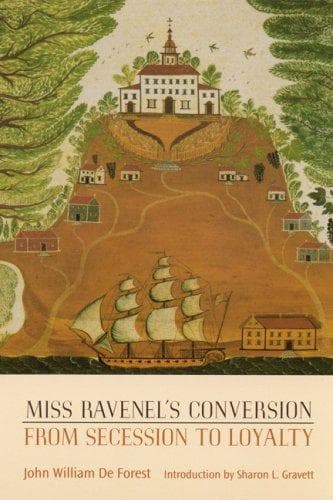
Miss Ravenel's conversion from secession to loyaltyDe Forest, John William
History
Miss Ravenel's conversion from secession to loyalty
De Forest, John William
Historical fiction; United States -- History -- Civil War, 1861-1865 -- Fiction; War stories; Women -- United States -- Fiction
The Doctor was honestly and intelligently delighted. He expressed his
admiration of the commanding general's motives and wisdom in such terms
that the latter, high as he was in position and mighty in authority,
felt flattered. You could not possibly talk with Ravenel for ten minutes
without thinking better of yourself than before; for, perceiving that
you had to do with a superior man, and that he treated you with
deference, you instinctively inferred that you were not only a person
but a personage. But the compliments and air of respect which he
accorded the commanding general were not mere empty civilities, nor
well-bred courtesies, nor expressions of consideration for place and
authority. Ravenel's enthusiasm led him to believe that, in finding a
man who sympathised with him in his pet project, he had found one of the
greatest minds of the age.
"At last," he said to his daughter when he reached home, "at last we
are likely to see wise justice meted out to these poor blacks."
"Is the Major-General pleasant?" asked Lillie, with an inconsequence
which was somewhat characteristic of her. She was more interested in
learning how a great dignitary looked and behaved than in hearing what
were his opinions on the subject of freemen's labor.
"I don't know that a major general is obliged to be pleasant, at least
not in war time," answered the Doctor, a little annoyed at the
interruption to the train of his ideas. "Yes, he is pleasant enough; in
fact something too much of deportment. He put me in mind of one of my
adventures among the Georgia Crackers. I had to put up for the night in
one of those miserable up-country log shanties where you can study
astronomy all night through the chinks in the roof, and where the man
and wife sleep one side of you and the children and dogs on the other.
The family, it seems, had had a quarrel with a neighboring family of
superior pretensions, which had not yet culminated in gouging or
shooting. The eldest daughter, a ragged girl of seventeen, described to
me with great gusto an encounter which had taken place between her
mother and the female chieftain of the hostile tribe. Said she, "Miss
Jones, she tried to come the dignerfied over mar. But thar she found her
beater. My mar is hell on dignerty."--Well, the Major-General runs
rather too luxuriantly to dignity. But his ideas on the subject of
reorganizing labor are excellent, and have my earnest respect and
approbation. I believe that under his administration the negroes will be
allowed and encouraged to take their first certain step toward
civilization. They are to receive some remuneration,--not for the bygone
centuries of forced labor and oppression,--but for what they will do
hereafter."
"I don't see, papa, that they have been treated much worse than they
might expect," responds Lillie, who, although now a firm loyalist, has
by no means become an abolitionist.
Public-domain text, read in full here on John Shaqi.
Reviews
Reviews
No reviews yet
Be the first to share your thoughts on this work.
Elsewhere in the archive
Join the Discussion
Join the discussion
Sign in to leave a comment or review.
Sign InorCreate an account