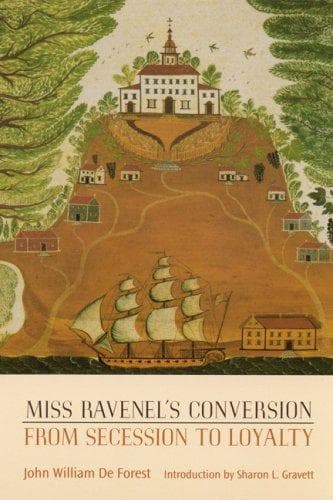
Miss Ravenel's conversion from secession to loyaltyDe Forest, John William
History
Miss Ravenel's conversion from secession to loyalty
De Forest, John William
Historical fiction; United States -- History -- Civil War, 1861-1865 -- Fiction; War stories; Women -- United States -- Fiction
"Perhaps not, my dear, perhaps not. They have no doubt been better off
in the Dahomey of America than they would have been in the Dahomey of
Africa; and certainly they couldn't expect much from a Christianity
whose chief corner-stone was a hogshead of slave-grown sugar. The
negroes were not foolish enough to look for much good in such a moral
atrocity as that. They have put their trust in the enemies of it; in
Frémont a while ago, and in Lincoln now. At present they do expect
something. They believe that 'the year of jubilo am come.' And so it is.
Before this year closes, many of these poor creatures will receive what
they never did before--wages for their labor. For the first time in
their lives they will be led to realize the idea of justice. Justice,
honesty, mercy, and nearly the whole list of Christian virtues, have
hitherto been empty names to them, having no practical signification,
and in fact utterly unknown to their minds except as words that for some
unexplained purpose had been inserted in the Bible. How could they
believe in the things themselves? They never saw them practiced; at
least they never felt their influence. Of course they were liars and
hypocrites and thieves. All constituted society lied to them by calling
them men and treating them as beasts; it played the hypocrite to them by
preaching to them the Christian virtues, and never itself practising
them; it played the thief by taking all the earnings of their labor,
except just enough to keep soul and body together, so that they might
labor more. Our consciences, the conscience of the nation, will not be
cleared when we have merely freed the negroes. We must civilize and
Christianize them. And we must begin this by teaching them the great
elementary duty of man in life--that of working for his own subsistence.
I am so interested in the problem that I have resolved to devote myself
personally to its solution."
"What! And give up your hospital?"
"Yes, my dear. I have already given it up, and got my plantation
assigned to me."
"Oh, papa! Where?"
Of course Lillie feared that in her new home she might not be able to
see her husband; and of course the Doctor divined this charming anxiety,
and hastened to relieve her from it.
"It is at Taylorsville, my dear. Taylorsville forms a part of Colonel
Carter's military jurisdiction, and the fort there is garrisoned by a
detachment from his brigade. He can come to see us without neglecting
his duties."
Lillie colored, and said nothing for a few minutes. She was so unused as
yet to her husband, that the thought of being visited by him thrilled
her nerves, and took temporary possession of all her mind.
"But, papa," she presently inquired, "will this support you as well as
the hospital?"
Public-domain text, read in full here on John Shaqi.
Reviews
Reviews
No reviews yet
Be the first to share your thoughts on this work.
Elsewhere in the archive
Join the Discussion
Join the discussion
Sign in to leave a comment or review.
Sign InorCreate an account