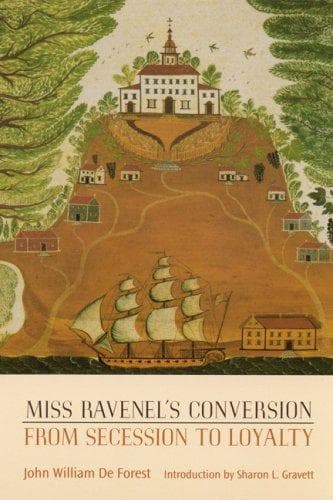
Miss Ravenel's conversion from secession to loyaltyDe Forest, John William
History
Miss Ravenel's conversion from secession to loyalty
De Forest, John William
Historical fiction; United States -- History -- Civil War, 1861-1865 -- Fiction; War stories; Women -- United States -- Fiction
"I don't know, child. It is an experiment. It may be a failure, and it
may be a pecuniary success. We shall certainly be obliged to economize
until our autumn crops are gathered. But I am willing to do that, if I
meet with no other reward than my own consciousness that I enter upon
the task for the sake of a long oppressed race. I believe that by means
of kindness and justice I can give them such ideas of industry and other
social virtues as they could not obtain, and have not obtained, from
centuries of robbery and cruelty."
Lillie was lost in meditation, not concerning the good of the blacks,
but concerning the probable visits of Colonel Carter at Taylorsville.
Affectionately selfish woman as she was, she would not have given up the
alarming joy of one of those anticipated interviews for the chance of
civilizing a capering wilderness of negroes.
Taylorsville, a flourishing village before the war, is situated on the
Mississippi just where it is tapped by Bayou Rouge, which is one of the
dozen channels through which the Father of Waters finds the Gulf of
Mexico. It is on the western bank of the river, and for the most part on
the southern bank of the bayou; and is protected from both by that
continuous system of levees which alone saves southern Louisiana from
yearly inundations. At the time of which I speak, a large portion of the
town consisted of charred and smoke-blackened ruins. Its citizens had
been mad enough to fire on our fleet, and Farragut had swept it with his
iron besoms of destruction. On the same bank of the Mississippi, but on
the northern bank of the bayou, at the apex of the angle formed by the
diverging currents, is Fort Winthrop, a small star-shaped earth-work,
faced in part with bricks, surrounded by a ditch except on the river
side, and provided with neither casemate nor bombproof. Ordered by
Butler and designed by Weitzel, it had been thrown up shortly after the
little victory of Georgia Landing. It was to be within reach of this
fort in case of an attack from raiding rebels, that Ravenel had selected
a plantation for his philanthropic experiment in the neighborhood of
Taylorsville. Haste was necessary to success, for the planting season
was slipping away. Within a week or so after the marriage he had bought
a stock of tools and provisions, obtained a ragged corps of negroes from
the Superintendent of Colored Labor, shipped every thing on board a
Government transport, and was on the spot where he proposed to initiate
the re-organization of southern industry.
Public-domain text, read in full here on John Shaqi.
Reviews
Reviews
No reviews yet
Be the first to share your thoughts on this work.
Elsewhere in the archive
Join the Discussion
Join the discussion
Sign in to leave a comment or review.
Sign InorCreate an account