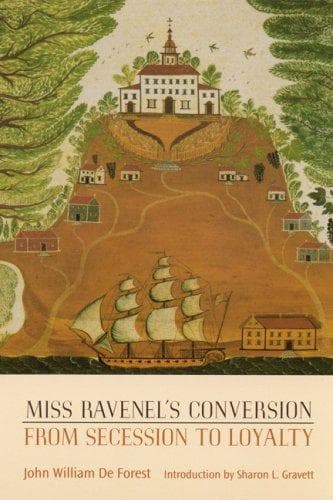
Miss Ravenel's conversion from secession to loyaltyDe Forest, John William
History
Miss Ravenel's conversion from secession to loyalty
De Forest, John William
Historical fiction; United States -- History -- Civil War, 1861-1865 -- Fiction; War stories; Women -- United States -- Fiction
Lillie snatched the paper, ran to her own room and read the official
bulletin over and over, dropping her tears upon it and kissing the place
where her husband was praised and recommended for promotion. Then she
thought how generous and grand he was to go forth to battle in silence,
without uttering a word to alarm her, without making an appeal for her
sympathy. The greatest men of history have not seemed so great to the
world as did this almost unknown colonel of volunteers to his wife. She
was in a passion, an almost unearthly ecstasy of grief, terror,
admiration and love. It is well that we cannot always feel thus
strongly; if we did, we should not average twenty years of life; if we
did, the human race would perish.
Next day came two letters from Carter, one written before and one after
the battle. In his description of the fighting he was as professional,
brief and unenthusiastic as usual, merely mentioning the fact of
success, narrating in two sentences the part which his brigade had taken
in the action, and saying nothing of his own dangers or performances.
But there was another subject on which he was more copious, and this
part of the letter Lillie prized most of all. "I am afraid I sicken you
with such fondness," he concluded. "It seems to me that you must get
tired of reading over and over again the same endearing phrases and pet
names."
"Oh, never imagine that I can sicken of hearing or reading that you love
me," she answered. "You must not cheat me of a single pet name; you must
call me by such names over and over in every letter. I always skim
through your letters to read those dear words first. I should be utterly
and forever miserable if I did not believe that you love me, and did not
hear so from you constantly."
At this time Lillie knew by heart all her husband's letters. Let her eye
rest on the envelope of one which she had received a week or a fortnight
previous, and she could repeat its contents almost verbatim, certainly
not missing one of the loving phrases aforesaid. Through the New Orleans
papers and these same wonderful epistles she followed the victorious
army in its onward march, now at Franklin, now at Opelousas, and now at
Alexandria. It was all good news, except that her husband was forever
going farther away; the Rebels were always flying, the triumphant
Unionists were always pursuing, and there were no more battles. She
flattered herself that the summer campaign was over, and that Carter
would soon get a leave of absence and come to his own home to be petted
and worshipped.
Public-domain text, read in full here on John Shaqi.
Reviews
Reviews
No reviews yet
Be the first to share your thoughts on this work.
Elsewhere in the archive
Join the Discussion
Join the discussion
Sign in to leave a comment or review.
Sign InorCreate an account