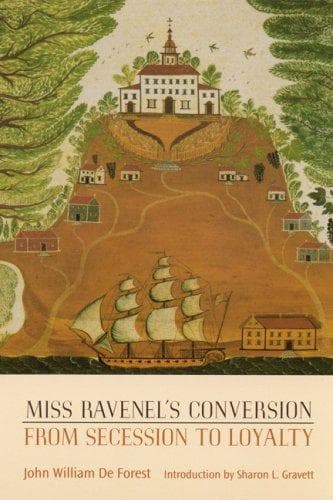
Miss Ravenel's conversion from secession to loyaltyDe Forest, John William
History
Miss Ravenel's conversion from secession to loyalty
De Forest, John William
Historical fiction; United States -- History -- Civil War, 1861-1865 -- Fiction; War stories; Women -- United States -- Fiction
From Alexandria arrived a letter of Colburne's to the Doctor. The young
man had needed all this time and these events to fortify him for the
task of writing to the Ravenels. For a while after that marriage it
seemed to him as if he never could have the courage to meet them, nor
even call to their attention the fact of his continued existence. His
congratulations were written with labored care, and the rest of the
letter in a style of affected gayety. I shall copy from it a single
extract, because it bears some relation to the grand reconstruction
experiment of the Doctor.
"I hear that you are doing your part towards organizing free labor in
Louisiana. I fear that you will find it an up-hill business, not only
from the nature of your surroundings but from that of your material. I
am as much of an abolitionist as ever, but not so much of a
'nigger-worshipper.' I don't know but that I shall yet become an
advocate of slavery. I frequently think that my boy Henry will fetch me
to it. He is an awful boy. He dances and gambles all night, and then
wants to sleep all day. If the nights and days were a thousand years
long apiece, he would keep it up in the same fashion. In order that he
may not be disturbed in his rest by my voice, he goes away from camp and
curls up in some refuge which I have not yet discovered. I pass hours
every day in shouting for Henry. Of course his labors are small and far
between. He brushes my boots in the morning because he doesn't go to bed
till after I get up; but if I want them polished during the day,--at
dress-parade, for instance,--it is not Henry who polishes them. When I
scold him for his worthlessness, he laughs most obstropolously (I value
myself on this word, because to my ear it describes Henry's laughter
exactly). For his services, or rather for what he ought to do and
doesn't, I pay him ten dollars a month, with rations and clothing. He
might earn two or three times as much on the levee at New Orleans; but
the lazy creature would rather not earn anything; he likes to get his
living gratis, as he does with me. This is the way he came to join me.
When I was last in New Orleans, Henry, whom I had previously known as
the body servant of one of my sergeants, paid me a visit. Said I, 'What
are you doing?'"
"'Workin' on 'ee levee.'
"'How much do you get?'
"'It's 'cordin' to what I doos. Ef I totes a big stent, I gits two
dollars; an' ef I totes 'nuff to kill a hoss, I gits two dollars 'n 'aff
a day.'
"'Why, that is grand pay. That is a great deal better than hanging
around camp for nothing but your board and clothes. I am glad you have
gone at some profitable and manly labor. Stick to it, and make a man of
yourself. Get some money in the bank, and then give yourself a little
schooling. You can make yourself as truly respectable as any white man,
Henry.'
Public-domain text, read in full here on John Shaqi.
Reviews
Reviews
No reviews yet
Be the first to share your thoughts on this work.
Elsewhere in the archive
Join the Discussion
Join the discussion
Sign in to leave a comment or review.
Sign InorCreate an account