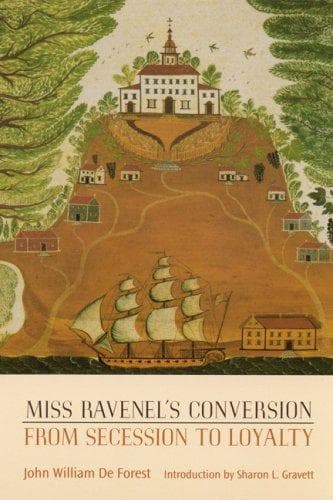
Miss Ravenel's conversion from secession to loyaltyDe Forest, John William
History
Miss Ravenel's conversion from secession to loyalty
De Forest, John William
Historical fiction; United States -- History -- Civil War, 1861-1865 -- Fiction; War stories; Women -- United States -- Fiction
The consideration of Mr. Colburne's letter induces me to take up once
more the thread of that young warrior's history. In the early part of
this month of May, 1863, we find him with his company, regiment and
brigade, encamped on the bank of the Red River, just outside of the once
flourishing little city of Alexandria, Louisiana. Under the protection
of a clapboard shanty, five feet broad and ten feet high, which three or
four of his men have voluntarily built for him, he is lying at full
length, smoking his short wooden pipe with a sense of luxury; for since
he left his tent at Brashear City, four weeks previous, this is the
first shelter which he has had to protect him from the rain, except one
or two ticklish mansions of rails, piled up by Henry of the
"obstropolous" laughter. The brigade encampment, a mushroom city which
has sprung up in a day, presenting every imaginable variety of temporary
cabin, reaches half a mile up and down the river, under the shade of a
long stretch of ashes and beeches. Hundreds of soldiers are bathing in
the reddish-ochre current, regardless of the possibility that the thick
woods of the opposite bank may conceal Rebel marksmen.
Colburne has eaten his dinner of fried pork and hardtack, has washed off
the grime of a three days' march, has finished his pipe, and is now
dropping gently into a soldier's child-like yet light slumber. He does
not mind the babble of voices about him, but if you should say "Fall
in!" he would be on his feet in an instant. He is a handsome model of a
warrior as he lies there, though rougher and plainer in dress than a
painter would be apt to make him. He is dark-red with sunburn; gaunt
with bad food, irregular food, fasting and severe marching; gaunt and
wiry, but all the hardier and stronger for it, like a wolf. His coarse
fatigue uniform is dirty with sleeping on the ground, and with marching
through mud and clouds of dust. It has been soaked over and over again
with rain or perspiration, and then powdered thickly with the
fine-grained, unctuous soil of Louisiana, until it is almost stiff
enough to stand alone. He cannot wash it, because it is the only suit he
has brought with him, and because moreover he never knows but that he
may be ordered to fall in and march at five minutes' notice.
Public-domain text, read in full here on John Shaqi.
Reviews
Reviews
No reviews yet
Be the first to share your thoughts on this work.
Elsewhere in the archive
Join the Discussion
Join the discussion
Sign in to leave a comment or review.
Sign InorCreate an account