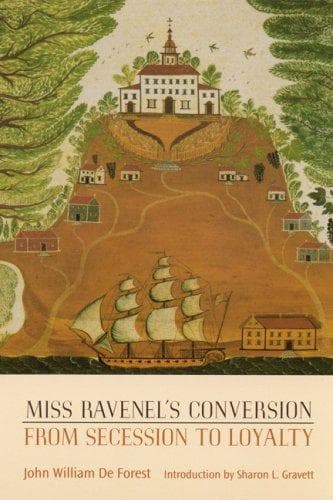
Miss Ravenel's conversion from secession to loyaltyDe Forest, John William
History
Miss Ravenel's conversion from secession to loyalty
De Forest, John William
Historical fiction; United States -- History -- Civil War, 1861-1865 -- Fiction; War stories; Women -- United States -- Fiction
Yet his body and even his mind are in the soundest and most enviable
health. His constant labors and hardships, and his occasional perils
have preserved him from that enfeebling melancholy which often infects
sensitive spirits upon whom has beaten a storm of trouble. Always in the
open air, never poisoned by the neighborhood of four walls and a roof,
he never catches cold, and rarely fails to have more appetite than food.
He has borne as well as the hardiest mason or farmer those terrific
forced marches which have brought the army from Camp Beasland to
Alexandria on a hot scent after the flying and scattering rebels. His
feet have been as sore as any man's; they have been blistered from toe
to heel, and swollen beyond their natural size; but he has never yet
laid down by the roadside nor crawled into an army wagon, saying that
he could march no further. He is loyal and manly in his endurance, and
is justly proud of it. In one of his letters he says, "I was fully
repaid for yesterday's stretch of thirty-five miles by overhearing one
of my Irishmen say, while washing his bloody feet, 'Be ----! but he's a
hardy man, the Captin!'--To which another responded, 'An' he had his
hands full to kape the byes' courage up; along in the afthernoon, he was
a jokin' an' scoldin' an' encouragin' for ten miles together. Be ----!
an' when _he_ gives out, it 'ull be for good rayson.'"
From Alexandria, Banks suddenly shifted his army to the junction of the
Red River with the Mississippi, and from thence by transport to a point
north of Port Hudson, thus cutting it off from communication with the
Confederacy. In this movement Weitzel took command of the Reserve
Brigade and covered the rear of the column. By night it made prodigious
marches, and by day lay in threatening line of battle. The Rebel
Cavalry, timid and puzzled, followed at a safe distance without
attacking. Now came the delicious sail from Simmsport to Bayou Sara,
during which Colburne could lounge at ease on the deck with a sense of
luxury in the mere consciousness that he was not marching, and repose
his mind, his eyes, his very muscles, by gazing on the fresh green
bluffs which faced each other across the river. To a native of hilly New
England, who had passed above a year on the flats of Louisiana, it was
delightful to look once more upon a rolling country.
Public-domain text, read in full here on John Shaqi.
Reviews
Reviews
No reviews yet
Be the first to share your thoughts on this work.
Elsewhere in the archive
Join the Discussion
Join the discussion
Sign in to leave a comment or review.
Sign InorCreate an account