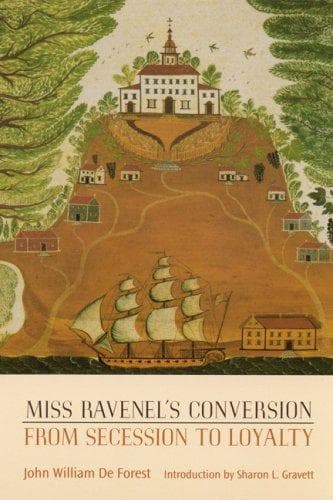
Miss Ravenel's conversion from secession to loyaltyDe Forest, John William
History
Miss Ravenel's conversion from secession to loyalty
De Forest, John William
Historical fiction; United States -- History -- Civil War, 1861-1865 -- Fiction; War stories; Women -- United States -- Fiction
It was through an atmosphere of scalding heat and stifling dust that the
brigade marched up the bluffs of Bayou Sara and over the rounded
eminences which stretched on to Port Hudson. The perspiration which
drenched the ragged uniforms and the pulverous soil which powdered them
rapidly mixed into a muddy plaster; and the same plaster grimed the
men's faces out of almost all semblance to humanity, except where the
dust clung dry and gray to hair, beard, eyebrows and eyelashes. So
dense was the distressing cloud that it was impossible at times to see
the length of a company. It seemed as if the men would go rabid with
thirst, and drive the officers mad with their pleadings to leave the
ranks for water, a privilege not allowable to any great extent in an
enemy's country. A lovely crystal streamlet, running knee-deep over
clean yellow sand, a charming contrast to black or brown bayous with
muddy and treacherous banks, was forded by the feverish ranks with
shouts and laughter of child-like enjoyment. But it was through volumes
of burning yet lazy dust, soiling and darkening the glory of sunset,
that the brigade reached its appointed bivouac in a large clearing, only
two miles from the rebel stronghold, though hidden from it by a dense
forest of oaks, beeches and magnolias.
It is too early to tell, it is even too early to know, the whole truth
concerning the siege of Port Hudson. To an honest man, anxious that the
world shall not be humbugged, it is a mournful reflection that perhaps
the whole truth never will be known to any one who will dare or care to
tell it. We gained a victory there; we took an important step towards
the end of the Rebellion; but at what cost, through what means, and by
whose merit? It was a capital idea, whosesoever it was, to clean out
Taylor's Texans and Louisianians from the Teche country before we
undertook the siege of Gardner's Arkansians, Alabamians, and
Mississippians at Port Hudson. But for somebody's blunder at that
well-named locality, Irish Bend, the plan would have succeeded better
than it did, and Taylor would not have been able to reorganize, take
Brashear City, threaten New Orleans, and come near driving Banks from
his main enterprise. As it was we opened the siege with fair prospects
of success, and no disturbing force in the rear. The garrison, lately
fifteen or twenty thousand strong, had been reduced to six thousand, in
order to reinforce Vicksburg; and Joe Johnston had already directed
Gardner to destroy his fortifications and transfer all his men to the
great scene of contest on the central Mississippi. Banks arrived from
Simmsport just in time to prevent the execution of this order. A smart
skirmish was fought, in which we lost more men than the enemy, but
forced Gardner to retire within his works, and accept the eventualities
of an investment.
Public-domain text, read in full here on John Shaqi.
Reviews
Reviews
No reviews yet
Be the first to share your thoughts on this work.
Elsewhere in the archive
Join the Discussion
Join the discussion
Sign in to leave a comment or review.
Sign InorCreate an account