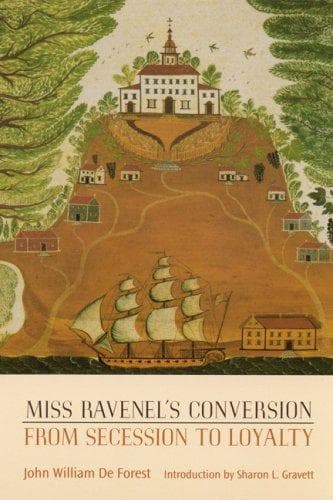
Miss Ravenel's conversion from secession to loyaltyDe Forest, John William
History
Miss Ravenel's conversion from secession to loyalty
De Forest, John William
Historical fiction; United States -- History -- Civil War, 1861-1865 -- Fiction; War stories; Women -- United States -- Fiction
To keep the ranks closed and aligned in any tolerable fighting shape
while struggling through that mile of tangled forest and broken ground,
was a task of terrible difficulty. Plunging through thickets, leaping
over fallen trees, a continuous foliage overhead, and the fallen leaves
of many seasons under foot, the air full of the damp, mouldering smell
of virgin forest, the brigade moved forward with no sound but that of
its own tramplings. It is peculiar of the American attack that it is
almost always made in line, and always without music. The men expected
to meet the enemy at every hillock, but they advanced rapidly, and
laughed at each other's slippings and tumbles. Every body was breathless
with climbing over obstacles or running around them. The officers were
beginning to swear at the broken ranks and unsteady pace. The
Lieutenant-Colonel, perceiving that the regiment was diverging from its
comrades, and fearing the consequences of a gap in case the enemy should
suddenly open fire, rode repeatedly up and down the line, yelling,
"Guide right! Close up to the right!" Suddenly, to the amazement of
every one, the brigade came upon bivouacs of Union regiments quietly
engaged in distributing rations and preparing breakfast.
"What are you doing up here?" asked a Major of Colburne.
"We are going to attack. Don't you take part in it?"
"I suppose so. I don't know. We have received no orders."
Through this scene of tardiness, the result perhaps of one of those
blunders which are known in military as well as in all other human
operations, Weitzel's division steadily advanced, much wondering if it
was to storm Port Hudson alone. The ground soon proved so difficult that
the Tenth, unable to move in line of battle, filed into a faintly marked
forest road and pushed forward by the flank in the ordinary column of
march. The battle had already commenced, although Colburne could see
nothing of it, and could hear nothing but a dull _pum-pum-pum_ of
cannon. He passed rude rifle-pits made of earth and large branches,
which had been carried only a few minutes previous by the confused rush
of the leading brigade. Away to the right, but not near enough to be
heard above the roar of artillery, there was a wild, scattering musketry
of broken lines, fighting and scrambling along as they best could over
thicketed knolls, and through rugged gullies, on the track of the
retiring Alabamians and Arkansans. It was the blindest and most
perplexing forest labyrinth conceivable; it was impossible to tell
whither you were going, or whether you would stumble on friends or
enemies; the regiments were split into little squads from which all
order had disappeared, but which nevertheless advanced.
Public-domain text, read in full here on John Shaqi.
Reviews
Reviews
No reviews yet
Be the first to share your thoughts on this work.
Elsewhere in the archive
Join the Discussion
Join the discussion
Sign in to leave a comment or review.
Sign InorCreate an account