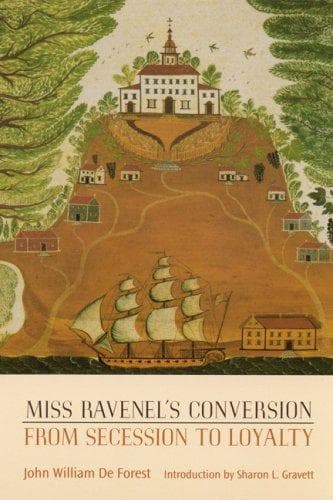
Miss Ravenel's conversion from secession to loyaltyDe Forest, John William
History
Miss Ravenel's conversion from secession to loyalty
De Forest, John William
Historical fiction; United States -- History -- Civil War, 1861-1865 -- Fiction; War stories; Women -- United States -- Fiction
The Tenth was still marching through the woods by the flank, unable to
see either fortifications or enemy, when it came under the fire of
artillery, and encountered the retiring stream of wounded. At this
moment, and for two hours afterward, the uproar of heavy guns, bursting
shells, falling trees and flying splinters was astonishing, stunning,
horrible, doubled as it was by the sonorous echoes of the forest.
Magnolias, oaks and beeches eighteen inches or two feet in diameter,
were cut asunder with a deafening scream of shot and of splitting
fibres, the tops falling after a pause of majestic deliberation, not
sidewise, but stem downwards, like a descending parachute, and striking
the earth with a dull shuddering thunder. They seemed to give up their
life with a roar of animate anguish, as if they were savage beasts, or
as if they were inhabited by Afreets and Demons.
The unusually horrible clamor and the many-sided nature of the danger
had an evident effect on the soldiers, hardened as they were to scenes
of ordinary battle. Grim faces turned in every direction with hasty
stares of alarm, looking aloft and on every side, as well as to the
front, for destruction. Pallid stragglers who had dropped out of the
leading brigade drifted by the Tenth, dodging from trunk to trunk in an
instinctive search for cover, although it was visible that the forest
was no protection, but rather an additional peril. Every regiment has
its two or three cowards, or perhaps its half-dozen, weakly-nerved
creatures, whom nothing can make fight, and who never do fight. One
abject hound, a corporal with his disgraced stripes upon his arm, came
by with a ghastly backward glare of horror, his face colorless, his eyes
projecting, and his chin shaking. Colburne cursed him for a poltroon,
struck him with the flat of his sabre, and dragged him into the ranks of
his own regiment; but the miserable creature was too thoroughly unmanned
by the great horror of death to be moved to any show of resentment or
even of courage by the indignity; he only gave an idiotic stare with
outstretched neck toward the front, then turned with a nervous jerk,
like that of a scared beast, and rushed rearward. Further on, six men
were standing in single file behind a large beech, holding each other by
the shoulders, when with a stunning crash the entire top of the tree
flew off and came down among them butt foremost, sending out a cloud of
dust and splinters. Colburne smiled grimly to see the paralyzed terror
of their upward stare, and the frantic flight which barely saved them
from being crushed jelly. A man who keeps the ranks hates a skulker, and
wishes that he may be killed, the same as any other enemy.
Public-domain text, read in full here on John Shaqi.
Reviews
Reviews
No reviews yet
Be the first to share your thoughts on this work.
Elsewhere in the archive
Join the Discussion
Join the discussion
Sign in to leave a comment or review.
Sign InorCreate an account