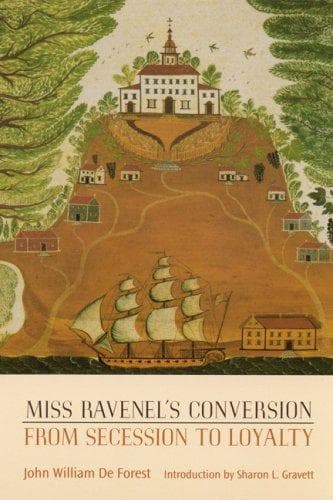
Miss Ravenel's conversion from secession to loyaltyDe Forest, John William
History
Miss Ravenel's conversion from secession to loyalty
De Forest, John William
Historical fiction; United States -- History -- Civil War, 1861-1865 -- Fiction; War stories; Women -- United States -- Fiction
The senior captain took command of the regiment, and led it to the left
on a line parallel with the fortifications. Colburne descended with his
little detachment, numbering about eighty muskets, into that Valley of
the Shadow of Death, climbing over or creeping under the fallen trunks
of the tangled labyrinth, and making straight for the bluff on which
thundered and smoked the rebel stronghold. As his men advanced they
deployed, spreading outwards like the diverging blades of a fan until
they covered a front of nearly a quarter of a mile. Every stump, every
prostrate trunk, every knoll and gulley was a temporary breastwork, from
behind which they poured a slow but fatal fire upon the rebel gunners,
who could be plainly seen upon the hostile parapet working their pieces.
The officers and sergeants moved up and down the line, each behind his
own platoon or section, steadily urging it forward.
"Move on, men. Move on, men," Colburne repeated. "Don't expose
yourselves. Use the covers; use the stumps. But keep moving on. Don't
take root. Don't stop till we reach the ditch."
In spite of their intelligent prudence the men were falling under the
incessant flight of bullets. A loud scream from a thicket a little to
Colburne's right attracted his attention.
"Who is that?" he called.
"It is Allen!" replied a sergeant. "He is shot through the body. Shall I
send him to the rear?"
"Not now, wait till we are relieved. Prop him up and leave him in the
shade."
He had in his mind this passage of the Army Regulations: "Soldiers must
not be permitted to leave the ranks to strip or rob the dead, nor even
to assist the wounded, unless by express permission, which is only to be
given after the action is decided. The highest interest and most
pressing duty is to win the victory, by which only can a proper care of
the wounded be ensured."
Turning to a soldier who had mounted a log and stood up at the full
height of his six feet to survey the fortifications, Colburne shouted,
"Jump down, you fool. You will get yourself hit for nothing."
"Captain, I can't see a chance for a shot," replied the fellow
deliberately.
"Get down!" reiterated Colburne; but the man had waited too long
already. Throwing up both hands he fell backward with an incoherent
gurgle, pierced through the lungs by a rifle-ball. Then a little Irish
soldier burst out swearing, and hastily pulled his trousers to glare at
a bullet-hole through the calf of his leg, with a comical expression of
mingled surprise, alarm and wrath. And so it went on: every few minutes
there was an oath of rage or a shriek of pain; and each outcry marked
the loss of a man. But all the while the line of skirmishers advanced.
Public-domain text, read in full here on John Shaqi.
Reviews
Reviews
No reviews yet
Be the first to share your thoughts on this work.
Elsewhere in the archive
Join the Discussion
Join the discussion
Sign in to leave a comment or review.
Sign InorCreate an account