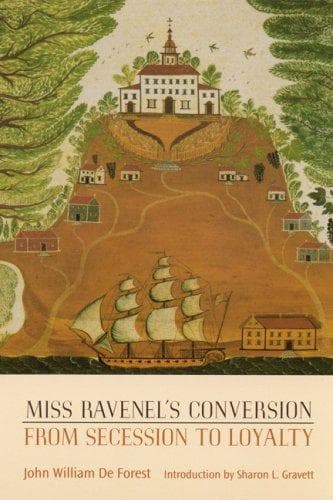
Miss Ravenel's conversion from secession to loyaltyDe Forest, John William
History
Miss Ravenel's conversion from secession to loyalty
De Forest, John William
Historical fiction; United States -- History -- Civil War, 1861-1865 -- Fiction; War stories; Women -- United States -- Fiction
The sickishness which troubled Colburne in the cannon-smitten forest had
gone, and was succeeded by the fierce excitement of close battle, where
the combatants grow angry and savage at sight of each other's faces. He
was throbbing with elation and confidence, for he had cleaned off the
gunners from the two pieces in his front. He felt as if he could take
Port Hudson with his detachment alone. The contest was raging in a
clamorous rattle of musketry on the right, where Paine's brigade, and
four regiments of the Reserve Brigade, all broken into detachments by
gullies, hillocks, thickets and fallen trees, were struggling to turn
and force the fortifications. On his left other companies of the Tenth
were slowly moving forward, deployed and firing as skirmishers. In his
front the Rebel musketry gradually slackened, and only now and then
could he see a broad-brimmed hat show above the earth-works and hear the
hoarse whistle of a Minie-ball as it passed him. The garrison on this
side was clearly both few in number and disheartened. It seemed to him
likely, yes even certain, that Port Hudson would be carried by storm
that morning. At the same time, half mad as he was with the glorious
intoxication of successful battle, he knew that it would be utter folly
to push his unsupported detachment into the works, and that such a
movement would probably end in slaughter or capture. Fifteen or twenty,
he did not know precisely how many, of his soldiers had been hit, and
the survivors were getting short of cartridges.
"Steady, men!" he shouted. "Halt! Take cover and hold your position.
Don't waste your powder. Fire slow and aim sure."
The orders were echoed from man to man along the extended, straggling
line, and each one disappeared behind the nearest thicket, stump or
fallen tree. Colburne had already sent three corporals to the regiment
to recount his success and beg for more men; but neither had the
messengers reappeared nor reinforcements arrived to support his proposed
assault.
"Those fellows must have got themselves shot," he said to Van Zandt.
"I'll go myself. Keep the line where it is, and save the cartridges."
Taking a single soldier with him, he hurried rearward by the clearest
course that he could find through the prostrate forest, without minding
the few bullets that whizzed by him. Suddenly he halted, powerless, as
if struck by paralysis, conscious of a general nervous shock, and a
sharp pain in his left arm. His first impulse,--a very hurried
impulse,--was to take the arm with his right hand and twist it to see if
the bone was broken. Next he looked about him for some shelter from the
scorching and crazing sunshine. He espied a green bush, and almost
immediately lost sight of it, for the shock made him faint although the
pain was but momentary.
"Are you hurt, Captain?" asked the soldier.
"Take me to that bush," said Colburne, pointing--for he knew where the
cover was, although he could not see it.
Public-domain text, read in full here on John Shaqi.
Reviews
Reviews
No reviews yet
Be the first to share your thoughts on this work.
Elsewhere in the archive
Join the Discussion
Join the discussion
Sign in to leave a comment or review.
Sign InorCreate an account