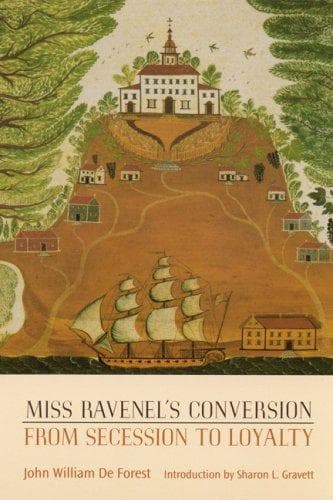
Miss Ravenel's conversion from secession to loyaltyDe Forest, John William
History
Miss Ravenel's conversion from secession to loyalty
De Forest, John William
Historical fiction; United States -- History -- Civil War, 1861-1865 -- Fiction; War stories; Women -- United States -- Fiction
In his fever he was childishly anxious about his quart cup; he was
afraid that the surgeon, the nurse, the visitors, would hit it and make
it swing. That arm was a little world of pain; it radiated pain as the
sun radiates light.
For the first time in his life he drank freely of strong liquors.
Whiskey was the internal panacea of the hospital, as iced water was the
outward one. Every time that the Surgeon visited the four officers he
sent a nurse for four milk punches, and if they wanted other stimulants,
such as claret or porter, they could have them for the asking. The
generosity of the Government, and the sublime beneficence of the
Sanitary Commission supplied every necessary and many luxuries. Colburne
was on his feet in forty-eight hours after his arrival, ashamed to lie
in bed under the eyes of that mangled and heroic Major. He was promoted
to the milk-toast table, and then to the apple-sauce table. Holding his
tin cup over his arm, he made frequent rounds of the hospital, cheering
up the wounded, and finding not a little pleasure in watching the
progress of individual cases. He never acquired a taste, as many did,
for frequenting the operating-room, and (as Van Zandt phrased it) seeing
them butcher. This _chevalier sans peur_, who on the battle-field could
face death and look upon ranks of slain unblenchingly, was at heart as
soft as a woman, and never saw a surgeon's knife touch living flesh
without a sensation of faintness.
He often accompanied the Chief Surgeon in his tours of inspection. A
wonder of practical philanthropy was this queer, cheerful, indefatigable
Doctor Jackson, as brisk and inspiriting as a mountain breeze, tireless
in body, fervent in spirit, a benediction with the rank of Major. Iced
water, whiskey, nourishment and encouragement were his cure-alls. There
were surgeons who themselves drank the claret and brandy of the Sanitary
Commission, and gave the remnant to their friends; who poured the
consolidated milk of the Sanitary Commission on the canned peaches of
the Sanitary Commission and put the grateful mess into their personal
stomachs; and who, having thus comforted themselves, went out with a
pleasant smile to see their patients eat bread without peaches and drink
coffee without milk. But Dr. Jackson was not one of these self-centred
individuals; he had fibres of sympathy which reached into the lives of
others, especially of the wretched. As he passed through the crowded
wards all those sick eyes turned to him as to a sun of strength and
hope. He never left a wounded man, however near to death, but the poor
fellow brightened up with a confidence of speedy recovery.
"Must cheer 'em--must cheer 'em," he muttered to Colburne. "Courage is a
great medicine--best in the world. Works miracles--yes, miracles."
"Why! how _are_ you, my old boy?" he said aloud, stopping before a
patient with a ball in the breast. "You look as hearty as a buck this
morning. Getting on wonderfully."
Public-domain text, read in full here on John Shaqi.
Reviews
Reviews
No reviews yet
Be the first to share your thoughts on this work.
Elsewhere in the archive
Join the Discussion
Join the discussion
Sign in to leave a comment or review.
Sign InorCreate an account