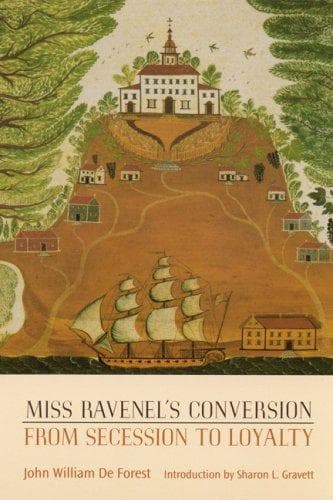
Miss Ravenel's conversion from secession to loyaltyDe Forest, John William
History
Miss Ravenel's conversion from secession to loyalty
De Forest, John William
Historical fiction; United States -- History -- Civil War, 1861-1865 -- Fiction; War stories; Women -- United States -- Fiction
It was a tiresome voyage from Springfield Landing to New Orleans.
Colburne had no place to lie down, and if he had had one he could not
have slept. During most of the trip he sat on a pile of baggage, holding
in his right hand a tin quart cup filled with ice and punctured with a
small hole, through which the chilled water, dripped upon his wounded
arm. Great was the excitement in the city when the ghastly travellers
landed. It was already known there that an assault had been delivered,
and that Port Hudson had not been taken; but no particulars had been
published which might indicate that the Union army had suffered a
severe repulse. Now, when several steamboats discharged a gigantic
freight of mutilated men, the facts of defeat and slaughter were
sanguinarily apparent. Secessionists of both sexes and all ages swarmed
in the streets, and filled them with a buzz of inhuman delight.
Creatures in the guise of womanhood laughed and told their little
children to laugh at the pallid faces which showed from the ambulances
as they went and returned in frequent journeys between the levee and the
hospitals. The officers and men of the garrison were sad, stern and
threatening in aspect. The few citizens who had declared for the Union
cowered by themselves and exchanged whispers of gloomy foreboding.
In St. Stephen's Hospital Colburne found something of that comfort which
a wounded man needs. His arm was dressed for the second time; his ragged
uniform, stiff with blood and dirt, was removed; he was sponged from
head to foot and laid in the first sheets which he had seen for months.
There were three other wounded officers in the room, each on his own
cot, each stripped stark naked and covered only by a sheet. A Major of a
Connecticut regiment, who had received a grapeshot through the lungs,
smiled at Colburne's arm and whispered, "Flea-bite." Then he pointed to
the horrible orifice in his own breast, through which the blood and
breath could be seen to bubble whenever the dressings were removed, and
nodded with another feeble but heroic smile which seemed to say, "This
is no flea-bite." Iced water appeared to be the only exterior medicament
in use, and the hospital nurses were constantly drenching the dressings
with this simple panacea of wise old Mother Nature. But in this early
stage of the great agony, before the citizens had found it in their
hearts to act the part of the Good Samaritan, there was a lack of
attendance. Happy were those officers who had their servants with them,
like the Connecticut Major, or who, like Colburne, had strength and
members left to take care of their own hurts. He soon hit upon a device
to lessen his self-healing labors. He got a nurse to drive a hook into
the ceiling and suspend his quart cup of ice to it by a triangle of
strings, so that it might hang about six inches above his wounded arm,
and shed its dew of consolation and health without trouble to himself.
Public-domain text, read in full here on John Shaqi.
Reviews
Reviews
No reviews yet
Be the first to share your thoughts on this work.
Elsewhere in the archive
Join the Discussion
Join the discussion
Sign in to leave a comment or review.
Sign InorCreate an account