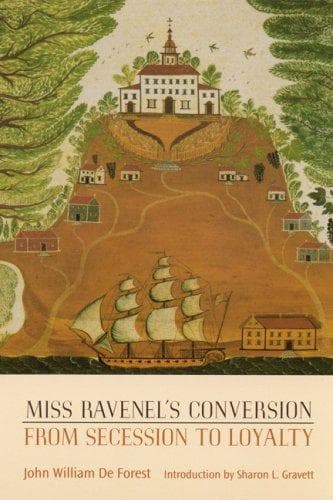
Miss Ravenel's conversion from secession to loyaltyDe Forest, John William
History
Miss Ravenel's conversion from secession to loyalty
De Forest, John William
Historical fiction; United States -- History -- Civil War, 1861-1865 -- Fiction; War stories; Women -- United States -- Fiction
Circumstances soon occurred which caused this lonely and anxious family
to be troubled about its own safety. To carry on the siege of Port
Hudson, Banks had been obliged to reduce the garrison of New Orleans and
of its vast exterior line of defences (a hundred miles from the city on
every side) to the lowest point consistent with safety. Meantime Taylor
reorganized the remnant of his beaten army, raised new levies by
conscription, procured reinforcements from Texas, and resumed the
offensive. Brashear City on the Atchafalaya, with its immense mass of
commissary stores, and garrison of raw Nine Months' men, was captured by
surprise. A smart little battle was fought at Lafourche Crossing, near
Thibodeaux, in which Greene's Texans charged with their usual brilliant
impetuosity, but were repulsed by our men with fearful slaughter after a
hand-to-hand struggle over the contested cannon. Nevertheless the Union
troops soon retired before superior numbers, and Greene's wild mounted
rangers were at liberty to patrol the Lafourche Interior.
"We can't stay here long," said Colburne, in the council of war in which
the family talked these matters over. "Greene will come this way sooner
or later. If he can take Fort Winthrop, he will thereby blockade the
Mississippi, cut off Banks' supplies, and force him to raise the siege
of Port Hudson. He is sure to try it sooner or later."
"Must we leave our plantation, then?" asked Ravenel in real anguish. To
lose his home, his invested capital, pigs, chickens, prospective crop of
vegetables, and, worse yet, of enlightened and ennobled negroes, was
indeed a torturing calamity. Had he known on the afternoon of that day,
that before morning the shaggy ponies and long, lank, dirty mosstroopers
of Greene's brigade would be upon him, he would not have paused to
examine the situation from so many different points of view. Colburne
knew by experience the celerity of Texan rangers; he had chased them in
forced marches from Brashear City to Alexandria without ever seeing a
tail of their horses; and yet even he indulged in a false security.
"I think we have twelve hours before us," he observed. "To-morrow
morning we shall have to get up and get, as the natives say. Still it's
my opinion--I don't believe Mrs. Carter had better stay here; she ought
to go to the fort to-night."
"Are you going, papa?" asked Mrs. Carter, who somehow was not much
alarmed.
"My dear, I must stay here till the last moment. We have so much
property here! You will have to go without me."
"Then I won't go," she answered; and so that was settled.
"_You_ ought to be off," said the Doctor to Colburne. "As a United
States officer you are sure to be kept a prisoner, if taken. I certainly
think that you ought to go."
Public-domain text, read in full here on John Shaqi.
Reviews
Reviews
No reviews yet
Be the first to share your thoughts on this work.
Elsewhere in the archive
Join the Discussion
Join the discussion
Sign in to leave a comment or review.
Sign InorCreate an account