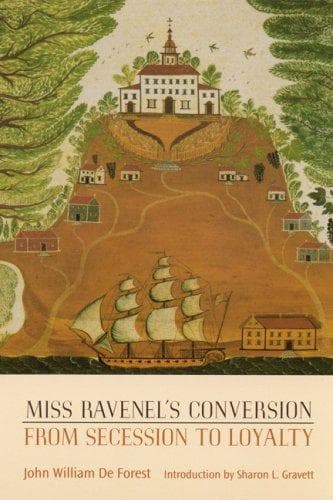
Miss Ravenel's conversion from secession to loyaltyDe Forest, John William
History
Miss Ravenel's conversion from secession to loyalty
De Forest, John William
Historical fiction; United States -- History -- Civil War, 1861-1865 -- Fiction; War stories; Women -- United States -- Fiction
"Scott, you and I will have to fight," he said aloud. "They never can
escape unless we keep the rascals here. We must fire once from the
house; then run to the woods and fire again there. We must show
ourselves men now."
"Yes, Mars Cap'm," replied the Major. His voice was tremulous, and his
whole frame shook, but he was nevertheless ready to die, if need be, for
his liberty and his benefactors. Of physical courage the poor fellow had
little; but in moral courage he was at this moment sublime.
Colburne posted himself and his comrade at a back corner of the house,
where they could obtain a view of the road which led toward Thibodeaux.
"Now, Scott," he said, "you must not fire until I have fired. You must
not fire until you have taken aim at somebody. You must fire only one
barrel. Then you must make for the woods along the line of this fence.
If they follow us on horseback we can bother them by dodging over the
fence now and then. If they catch us, we must fight as long as we can.
Cheer up, old fellow. It's all right. It's not bad business as soon as
you're used to it."
"Cap'm, I'se ready," answered Scott solemnly. "I'se not gwine for ter be
cotched alive."
Then he prayed for some minutes in a low whisper, while Colburne stood
at the corner and watched. "Watch and pray," the latter repeated to
himself, smiling inwardly at the odd compliance with the double
injunction, so strangely does the mind work on such occasions. It was
not a deliberate process of intellection with him; it was an instinctive
flash of ideas, not traceable to any feeling which was in him at the
time; on the contrary, his prevailing emotion was one of extreme
anxiety. The tramp which fled toward the fort gently diminished in the
distance, while the tramp which approached from the opposite side grew
nearer and louder. When the advancing horsemen got within a hundred
yards of the house, they slackened their pace to a walk, and finally
halted, probably to listen. Some of them must have dismounted at this
time, for Colburne suddenly beheld four footmen at the front gate. He
scowled at this sign of experienced caution, and gave a hasty glance
toward the garden in his rear, to see if others were not cutting off his
retreat. He could not discover the features of any of the four, but he
could see that they were of the tall and lank Texan type, dressed in
brownish clothing, and provided with short guns, no doubt
double-barreled fowling-pieces. Inside of the gate they halted and
seemed to hearken, while one of them pointed up the road toward the
fort, and whispered to his comrades. Colburne had hoped that they would
get into the house, and fall to plundering; but they had evidently
overheard the fugitives, for there was a simultaneous backward movement
in the group--they were going to remount and pursue. Now was his time,
if ever, to effect the proposed diversion. Aiming his six-inch revolver
at the tallest, he fired a single barrel. The man yelled a curse,
Public-domain text, read in full here on John Shaqi.
Reviews
Reviews
No reviews yet
Be the first to share your thoughts on this work.
Elsewhere in the archive
Join the Discussion
Join the discussion
Sign in to leave a comment or review.
Sign InorCreate an account