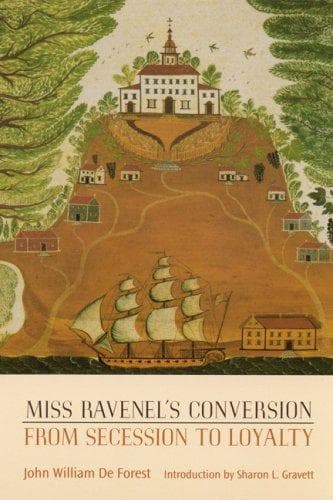
Miss Ravenel's conversion from secession to loyaltyDe Forest, John William
History
Miss Ravenel's conversion from secession to loyalty
De Forest, John William
Historical fiction; United States -- History -- Civil War, 1861-1865 -- Fiction; War stories; Women -- United States -- Fiction
staggered, dropped his gun, and leaned against the fence. Two of his
comrades sprang across the road, and threw themselves behind the levee
as a breast-work, while the fourth, all grit, turned short and brought
his fowling-piece to a level as Colburne drew behind his cover. In that
same moment, Major Scott, wild with a sudden madness of conflict,
shouted like a lion, bounded beyond the angle of the house, planting
himself on two feet set wide apart, his mad black face set toward the
enemy, and his gun aimed. Both fired at the same instant, and both fell
together, probably alike lifeless. The last prayer of the negro was, "My
God!" and the last curse of the rebel was "Damnation!"
By the light of the moon Colburne looked at his comrade, and saw the
brains following the blood from a hole in the centre of his forehead. He
cast a glance at the levee, fired one more barrel at a broad-brimmed hat
which rose above it, listened for a second to an advancing rush of hoofs
in order to decide whether it came by the road or by the fields, turned,
crossed the garden on a noiseless run, placed himself on the further
side of a high and close plantation-fence, and followed its cover
rapidly toward the forest. The distance was less than a quarter of a
mile, but he was quite breathless and faint before he had traversed it,
so weak was he still, and so little accustomed to exercise. In the edge
of the wood he sat down on a fallen and mouldering trunk to listen. If
the cavalry were pursuing their course up the road, they were doing it
very prudently and slowly, for he could hear no more trampling of
horses. Tolerably satisfied as to the safety of the Ravenels, he
reloaded his two empty barrels, settled his course in his mind, and
pushed as straight as he could for Taylorsville without quitting the
cover of the forest. Although the fort was not four miles away in a
direct line, it was daybreak when he came in sight of a low flattened
outline, as of a truncated mound, which showed dimly through the
yellowish morning mist. He had still to cross a dead level of four or
five hundred yards, with no points of shelter but three small wooden
houses. At this moment, when safety seemed so near and sure, he saw on
the bayou road, two hundred yards to his right, half a dozen black and
indistinct bunches moving in a direction parallel to his own. They were
unquestionably horsemen going toward the fort, and nearer to it than he.
Changing his direction, he made straight for the river, struck it above
the fortification, and got behind the levee, thus securing both a
covered way to hide his course, and an earthwork from behind which he
could fight. He lost no time in peeping over the top of the mound, but
pushed ahead at his best speed, supposing that no cavalry scouts would
dare approach very near to a garrison supplied with artillery. He could
see a sentry pacing the ramparts, the dark uniform showing clear against
the grey sky beyond.
Public-domain text, read in full here on John Shaqi.
Reviews
Reviews
No reviews yet
Be the first to share your thoughts on this work.
Elsewhere in the archive
Join the Discussion
Join the discussion
Sign in to leave a comment or review.
Sign InorCreate an account