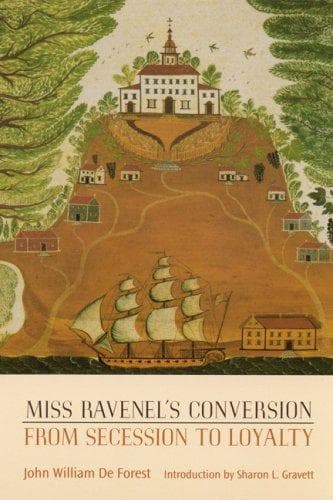
Miss Ravenel's conversion from secession to loyaltyDe Forest, John William
History
Miss Ravenel's conversion from secession to loyalty
De Forest, John William
Historical fiction; United States -- History -- Civil War, 1861-1865 -- Fiction; War stories; Women -- United States -- Fiction
Colburne, by the way, had never asked for promotion,
believing, with the faith of chivalrous youth, that merit would be sure
of undemanded recognition.
After several calls of "Major!" the slumberer came to his
consciousness; he used it by rolling over on his side, and endeavoring
to resume his dozings. He had not been able to sleep till late the night
before on account of his terrors, and now he was reposing like an
animal, anxious chiefly to be let alone.
"Major--excuse me--I have something of importance to report," insisted
the Captain.
"Well; what is it?" snarled Gazaway. Then, catching sight of Colburne,
"Oh! that you, Cap? Where _you_ from?"
"From a plantation five miles below, on the bayou. I was followed in
closely by the rebel cavalry. Their pickets are less than half a mile
from the fort."
"My God!" exclaimed Gazaway, sitting up and throwing off his
musquito-net. "What do you think? They ain't going to attack the fort,
be they?" Then calling his homespun pomposity to his aid, he added, with
a show of bravado, "I can't see it. They know better. We can knock spots
out of 'em."
"Of course we can," coincided the Captain. "I don't believe they have
any siege artillery; and if we can't beat off an assault we ought to be
cat-o'-nine-tailed."
"Cap, I vow I wish I had your health," said the Major, gazing
shamelessly at Colburne's thin and pale face. "You can stand anything. I
used to think I could, but this cussed climate fetches _me_. I swear I
hain't been myself since I come to Louisianny."
It is true that the Major had not been in field service what he once
honestly thought he was. He had supposed himself to be a brave man; he
was never disenchanted of this belief except while on the battle-field;
and after he had run away he always said and tried to believe that it
was because he was sick.
"I was took sick with my old trouble," he continued; "same as I had at
New Orleans, you know--the very day that we attacked Port Hudson."
By the way, he had not had it at New Orleans; he had had it at Georgia
Landing and Camp Beasland; but Colburne did not correct him.
Public-domain text, read in full here on John Shaqi.
Reviews
Reviews
No reviews yet
Be the first to share your thoughts on this work.
Elsewhere in the archive
Join the Discussion
Join the discussion
Sign in to leave a comment or review.
Sign InorCreate an account