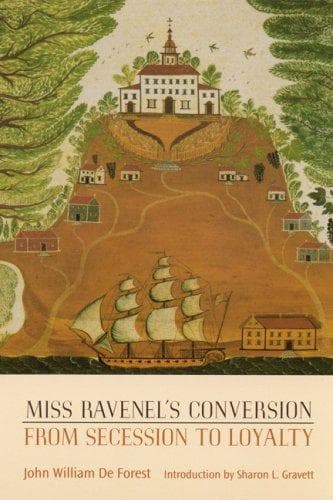
Miss Ravenel's conversion from secession to loyaltyDe Forest, John William
History
Miss Ravenel's conversion from secession to loyalty
De Forest, John William
Historical fiction; United States -- History -- Civil War, 1861-1865 -- Fiction; War stories; Women -- United States -- Fiction
Then the young soldier bethought himself that he ought to report his
knowledge of the rebels to the commandant of the garrison. "You'll find
the cuss in there," said a devil-may-care lieutenant, pointing to a
brick structure in the centre of the fort. Colburne entered, saw an
officer sleeping on a pile of blankets, and to his astonishment
recognized him as Major Gazaway. In slumber this remarkable poltroon
looked respectably formidable. He was six feet in height and nearly two
hundred pounds in weight, large-limbed, deep-chested, broad-shouldered,
dark in complexion, aquiline in feature, masculine and even stern in
expression. He had begun life as a prize fighter, but had failed in that
career, not because he lacked strength or skill, but from want of pluck
to stand the hammering. Nevertheless he was a tolerable hand at a
rough-and-tumble fight, and still more efficient in election-day
bullying and browbeating. For the last ten years he had kept a billiard
saloon, had held various small public offices, and had been the Isaiah
Rynders of his little city. On the stump he had a low kind of popular
eloquence made up of coarse denunciation, slanderous lying, bar-room
slang, smutty stories, and profanity. The Rebellion broke out; the Rebel
cannon aimed at Fort Sumter knocked the breath out of the Democratic
party; and Gazaway turned Republican, bringing over two hundred fighting
voters, and changing the political complexion of his district.
Consequently he easily got a commission as captain in the three months'
campaign, and subsequently as major in the Tenth, much to the disgust of
its commandant. He had expected and demanded a colonelcy; he thought
that the Governor, in not granting it, had treated him with ingratitude
and black injustice; he honestly believed this, and was naively sore and
angry on the subject. It needed this trait of born impudence to render
his character altogether contemptible; for had he been a conscious,
humble coward, he would have merited a pity not altogether disunited
from respect. From the day of receiving his commission Gazaway had not
ceased to intrigue and bully for promotion in a long series of blotted
and ill-spelled letters. How could a mere Major ever hope to go before
the people successfully as a candidate for Congress? That distinction
was the aim of Gazaway, as of many another more or less successful
blackguard. It is true that these horrid battles occasionally shook his
ambition and his confidence in his own merits. Under fire he was a meek
man, much given to lying low, to praying fervently, to thinking that a
whole skin was better than laurels. But in a few hours after the danger
was past, his elastic vanity and selfishness rose to the occasion, and
he was as pompous in air, as dogmatical in speech, as impudently greedy
in his demands for advancement as ever. Such was one of Colburne's
superior officers; such was the dastard to whom the wounded hero
reported for duty.
Public-domain text, read in full here on John Shaqi.
Reviews
Reviews
No reviews yet
Be the first to share your thoughts on this work.
Elsewhere in the archive
Join the Discussion
Join the discussion
Sign in to leave a comment or review.
Sign InorCreate an account