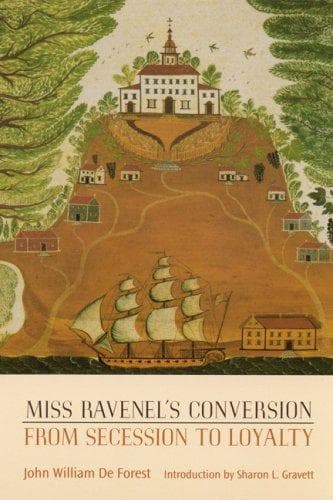
Miss Ravenel's conversion from secession to loyaltyDe Forest, John William
History
Miss Ravenel's conversion from secession to loyalty
De Forest, John William
Historical fiction; United States -- History -- Civil War, 1861-1865 -- Fiction; War stories; Women -- United States -- Fiction
The months which she passed at Thibodeaux were the happiest that she had
ever known. The Colonel did not drink; was with her every moment that he
could spare from his duties; was strongly loving and noisily cheerful,
like a doting dragoon as he was; abounded with attentions and presents,
bouquets from the garden, and dresses from New Orleans; was uneasy to
make her comfortable, and exhibit his affection. The whole brigade knew
her, and delighted to look at her, drilling badly in consequence of
inattention when she cantered by on horseback. The sentinels, when not
watched by the lieutenant of the guard, gratified themselves and amused
her with the courteous pleasantry of presenting arms as she passed. Such
officers as were aristocratic enough or otherwise fortunate enough to
obtain a bowing acquaintance, still more to be invited to her receptions
and dinner parties, flattered her by their evident admiration and
devotion. A second lieutenant who once had a chance to shorten her
stirrup leather, alluded to it vain-gloriously for weeks afterward, and
received the nickname from his envious comrades of "Acting Assistant
Flunkey General, Second Brigade, First Division, Nineteenth Army Corps."
It made no difference with the happy youth; he had shortened the stirrup
of the being who was every body's admiration; and from his pedestal of
good fortune he smiled serenely at detraction. Lillie was the queen, the
goddess, the only queen and goddess, of the Lafourche Interieur. In the
whole district there was no other lady, except the wives of two
captains, who occupied a much lower heaven, and some bitter
Secessionists, who kept aloof from the army, and were besides wofully
scant in their graces and wardrobe. The adulation which she received did
not come from the highest human source, but it was unmixed, unshared,
whole-souled, constant. She thought it was the most delightful thing
conceivable to keep house, to be married, to be the wife of Colonel
Carter. If she had been twenty-five or thirty years old, a veteran of
society, I should be inclined to laugh at her for the child-like
pleasure she took in her conditions and surroundings; but only twenty,
hardly ever at a party, married without a wedding, married less than six
months, I sympathise with her, rejoice with her, in her unaccustomed
intoxication of happiness. It was curious to see how slowly she got
accustomed to her husband. For some time it seemed to her amazing and
almost incredible that any man should call himself by such a title, and
claim the familiarity and the rights which it implied. She frequently
blushed at encountering him, as if he were still a lover. If she met the
bold gaze of his wide-open brown eyes, she trembled with an inward
thrill, and wanted to say, "Please don't look at me so!" He could
tyrannize over her with his eyes; he could make her come to him and try
to hide from them by nestling her head on his shoulder; he used to
Public-domain text, read in full here on John Shaqi.
Reviews
Reviews
No reviews yet
Be the first to share your thoughts on this work.
Elsewhere in the archive
Join the Discussion
Join the discussion
Sign in to leave a comment or review.
Sign InorCreate an account