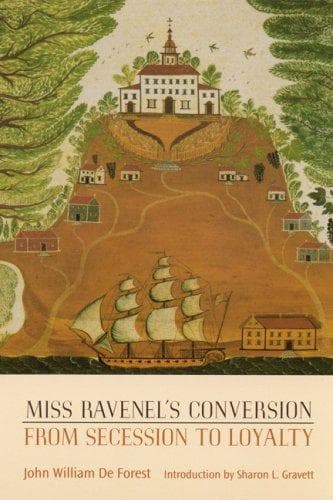
Miss Ravenel's conversion from secession to loyaltyDe Forest, John William
History
Miss Ravenel's conversion from secession to loyalty
De Forest, John William
Historical fiction; United States -- History -- Civil War, 1861-1865 -- Fiction; War stories; Women -- United States -- Fiction
wonder at his power, and gratify his vanity as well as his affection, by
using it.
An officer of the staff, who believed in the marvels of the so-called
psychologists, observed the emotion awakened in the wife by the
husband's gaze, and mentioned it to Colburne as a proof of the actuality
of magnetíco-spiritualistic influence. The Captain was not convinced,
and felt a strong desire to box the officer's ears. What right had the
fellow to make the movements and inclinations of that woman's soul an
object of curiosity and a topic of conversation? He offered no reply to
the remark, and glared in a way which astonished the other, who had the
want of delicacy common to men of one idea. Colburne divined Mrs. Carter
too well to adopt the magnetic theory. Judging her nature out of the
depths of his own, he believed that love was the true and all-sufficient
explanation of her nervousness under the gaze of her husband. It was a
painful belief: firstly, for the very natural reason that he was not
himself the cause of the emotion; secondly, because he feared that the
Colonel might be a blight to the delicate affection which clasped him
with its tendrils.
His relations with both were the most familiar, the frankest, the
kindest. When Carter could not ride out with his wife, he detailed
Colburne for the agreeable duty. When Mrs. Carter made a visit to
headquarters, and did not find the Colonel there, she asked for the
adjutant-general. The friend sent the lady bouquets by the hands of the
husband. Carter knew to some extent how Colburne adored Lillie, but he
had a fine confidence in the purity and humility of the adoration, and
he trusted her to him as he would have trusted her to her father. The
Captain was not a member of the family: the cottage was too far from his
official duties to allow of that; but he dined there every Sunday, and
called there every other evening. Ravenel's letters to one or the other,
were the common property of both. If Lillie did not hear from her father
twice a week, and therefore became anxious about him, because it was the
yellow fever season, or because of the broad fact that man is mortal,
she applied to Colburne as well as to her husband for comforting
suggestions and assurances. In company with some chance fourth, these
three had the gayest evenings of whist and euchre. Lillie never looked
at her cards without exciting the laughter of the two men, by declaring
that she hadn't a thing in her hand--positively not a single
thing--couldn't take a trick--not one. She talked perpetually, told what
honors she held, stole glances at her opponent's hand, screamed with
delight when she won, and in short violated all the venerable rules of
whist. She forgot the run of the cards, trumped her partner's trick, led
diamonds when he had trashed on hearts, led the queen when she held ace
and king. To her trumps she held on firmly, never showing them till the
last moment, and scolding her partner if he called them out. She
Public-domain text, read in full here on John Shaqi.
Reviews
Reviews
No reviews yet
Be the first to share your thoughts on this work.
Elsewhere in the archive
Join the Discussion
Join the discussion
Sign in to leave a comment or review.
Sign InorCreate an account