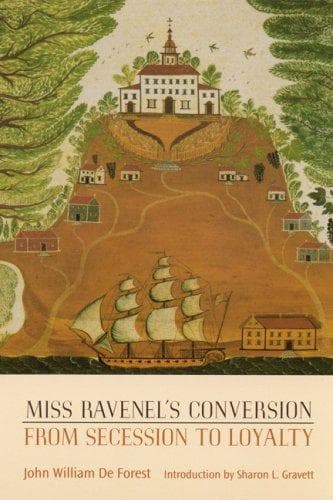
Miss Ravenel's conversion from secession to loyaltyDe Forest, John William
History
Miss Ravenel's conversion from secession to loyalty
De Forest, John William
Historical fiction; United States -- History -- Civil War, 1861-1865 -- Fiction; War stories; Women -- United States -- Fiction
After this Carter treated his wife with increased tenderness. Nothing
that she desired was too good for her, or too difficult to get. He
sought to check the constant exercise which she delighted in, and
especially her long rides on horseback; and when with a sweet, laughing
wilfulness she defied his authority, he watched her with evident
anxiety. He wrote about it all to her father, and the consequence was a
visit from the Doctor. This combination of natural potentates was
victorious, and equestrianism was given up for walking and tending
flowers. At this time she had so much affection to spare that she
lavished treasures of it, not only on plants, but on birds, cats, dogs,
and ponies. Here Colburne drifted into the circle of her sympathies. He
was fond of pets, especially of weak ones, for instance liking cats
better than dogs, and liking them all the more because most people
abused and, as he contended, misunderstood them. He had stories to tell
of feline creatures who had loved him with a love like that of Jonathan
for David, passing the love of woman. There was the abnormally sensitive
Tabby who pined away with grief when his mother died, and the
uncomformably intelligent Tom who persisted in getting into his trunk
when he was packing it to go to the wars.
"I am confident," he asserted, "that Puss knew I was about to leave, and
wanted to be taken along."
Lillie did not question it; all love, even that of animals, seemed
natural to her; she felt (not thought) that love was the teacher of the
soul.
By the way, Colburne's passion for pets had deep roots in his character.
It sprang from his pitying fondness for the weak, and was closely
related to his sympathies with humanity. It extended to the feebler
members of his own race, such as children and old ladies, whom, he
befriended and petted whenever he could, and who in return granted him
their easily-won affection. For flowers, and in general for inanimate
nature, he cared little; never could be induced to study botany, nor to
understand why other people should study it; could not see any human
interest in it. Geology he liked, because it promised, he thought, some
knowledge of the early history of man, or at least of the grand cosmical
preparation for his advent. Astronomy was also interesting to him,
inasmuch as we may at some future time traverse sidereal spaces. The
most interesting star in the heavens, to his mind, was that one in the
Pleiades which is supposed to be the central sun of our solar and
planetary system. Around this all that he knew and all whom he loved
revolved, even including Mrs. Carter.
Public-domain text, read in full here on John Shaqi.
Reviews
Reviews
No reviews yet
Be the first to share your thoughts on this work.
Elsewhere in the archive
Join the Discussion
Join the discussion
Sign in to leave a comment or review.
Sign InorCreate an account