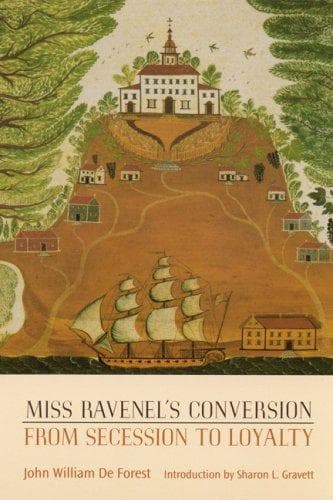
Miss Ravenel's conversion from secession to loyaltyDe Forest, John William
History
Miss Ravenel's conversion from secession to loyalty
De Forest, John William
Historical fiction; United States -- History -- Civil War, 1861-1865 -- Fiction; War stories; Women -- United States -- Fiction
I presume that this summer was the happiest period in the life of the
Colonel. He was in fine health, thanks to his present temperate ways,
although they reduced his weight so rapidly that his wife thought he was
sick, and became alarmed about him. He frequently recommended marriage
to Colburne, and they had long conversations on the subject; not,
however, before Mrs. Carter, whose entrance always caused the Captain to
drop the subject. The Telemachus was as fully persuaded of the benefits,
happiness and duty of wedded life as the Mentor, and was much the best
theorizer.
"I believe," he said, "that neither man nor woman is a complete nature
by himself or herself, and that you must unite the two in one before
humanity is perfected, and, to use an Emersonianism, comes full circle.
The union is affection, and the consecration of it is marriage. You
remember Baron Munchausen's horse; how he was cut in two, and the halves
got on very poorly without each other; and how they were reunited with
mutual benefit. Now this is the history of every bachelor and single
woman, who having miserably tried for a while to go it alone, finally
coalesce happily in one flesh."
"By Jove, Captain, you talk like a philosopher," said the Colonel. "You
ought to write something. You ought to practice, too, according to your
preaching. There is Mrs. Larue, now. No," he added seriously. "Don't
take her. She isn't worthy of you. You deserve the best."
Colburne was a better conversationalist than Carter, except in the way
of small talk with comparative strangers, wherein the latter's
confidence in himself, strengthened by habits of authority, gave him an
easy freedom. Indeed, when Carter was actually brilliant in society, you
might be sure he had taken five or six plain whiskeys, and that five or
six more (what a head he sported!) would make him moderately drunk. If
my readers will go back to the dinner at Professor Whitewood's, and the
evening which followed it, and the next day's pic-nic when he was under
the influence of a whiskey fever, they will see the best that he could
do as a talker. With regard to subjects which implied ever so little
scholarship, the Colonel accorded the Captain a facile admiration which
at first astonished the latter. Talking one day of the earth-works of
Port Hudson, Colburne observed that the Romans threw up field
fortifications at the close of every day's march, one legion standing
under arms to protect the workmen, while another marched out and formed
line of battle to cover the foragers. If the brigade commander had ever
known these things, he had evidently forgotten them. He looked at
Colburne with undisguised astonishment, and set him down from that
moment as a fellow of infinite erudition. This was far from being the
only occasion on which the volunteer captain was led to notice the
narrow professional basis from which most of the officers of the old
service talked and thought. Now and then he met a philosopher like
Public-domain text, read in full here on John Shaqi.
Reviews
Reviews
No reviews yet
Be the first to share your thoughts on this work.
Elsewhere in the archive
Join the Discussion
Join the discussion
Sign in to leave a comment or review.
Sign InorCreate an account