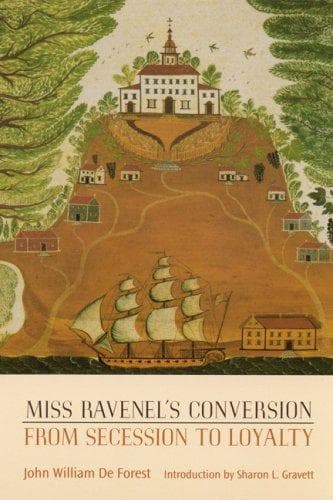
Miss Ravenel's conversion from secession to loyaltyDe Forest, John William
History
Miss Ravenel's conversion from secession to loyalty
De Forest, John William
Historical fiction; United States -- History -- Civil War, 1861-1865 -- Fiction; War stories; Women -- United States -- Fiction
"In a general way," says Colburne, "we are sadly off for amusements.
Fowling is not allowed because the noise of the guns alarms the pickets.
Even alligators I have only shot at once, when I garrisoned a little
post four miles from camp, and, being left without rations, was obliged
to subsist my company for a day on boiled Saurian. The meat was eatable,
but not recommendable to persons of delicate appetite, being of an
ancient and musky flavor, as though it had been put up in its horny case
a thousand years ago. By the way, a minie ball knocks a hole in these
fellows' celebrated jackets without the slightest difficulty. As for
riding after hounds or on steeple chases, or boxing, or making up
running or rowing matches, after the gymnastic fashion of English
officers, we never think of it. Now and then there is a horse-race, but
for the most part we play euchre. Drill is no longer an amusement as at
first, but an inexpressibly wearisome monotony. Conversation is
profitless and dull, except when it is professional or larkish. With the
citizens we have no dealings at all, and I have not spoken to a lady
since I left New Orleans. Books are few because we cannot carry them
about, being limited in our baggage to a carpet-sack; and moreover I
have lost my taste for reading, and even for all kinds of thinking
except on military matters. My brother officers, you know, are brave,
sensible and useful men, but would not answer to fill the professorial
chairs of Winslow University. They represent the plain people whose
cause is being fought out in this war against an aristocracy. When I
first went into camp with the regiment they humorously recognized my
very slight fashionable elevation by styling my company, which then
numbered eighteen men, 'The Upper Ten Thousand.' Now all such
distinctions are rubbed out; it is, who can fight best, march best,
command best; each one stands on the base of his individual manhood. In
the army a man cannot remain long on a social pedestal which will enable
him to overlook the top of his own head. He can obtain no respect which
is not accorded to rank or merit; and very little merit is acknowledged
except what is of a professional character."
With true _esprit du corps_ he frequently expatiates on the excellencies
of his regiment.
"The discipline in the Tenth is good," he declares, "and consequently
there are no mutinies, no desertions and not much growling. Ask the
soldiers if they are satisfied with the service, and they might answer,
'No;' but you cannot always judge of a man by what he says, even in his
impulsive moments; you must also consider what he does. Look at an old
man-of-war's man: he growls on the forecastle, but is as meek as Moses
on the quarter-deck; and, notwithstanding all his mutterings, he is
always at his post and does his duty with a will. Just so our soldiers
frequently say that they only want to get out of the service, but never
run away and rarely manoeuvre for a discharge."
Public-domain text, read in full here on John Shaqi.
Reviews
Reviews
No reviews yet
Be the first to share your thoughts on this work.
Elsewhere in the archive
Join the Discussion
Join the discussion
Sign in to leave a comment or review.
Sign InorCreate an account