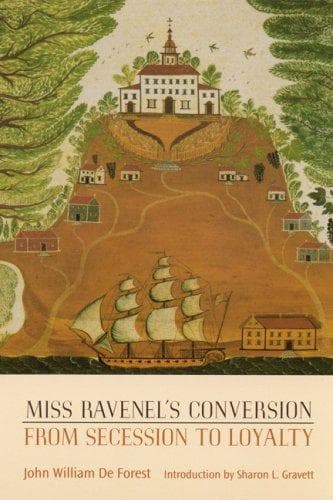
Miss Ravenel's conversion from secession to loyaltyDe Forest, John William
History
Miss Ravenel's conversion from secession to loyalty
De Forest, John William
Historical fiction; United States -- History -- Civil War, 1861-1865 -- Fiction; War stories; Women -- United States -- Fiction
This, it will be observed, was before the days of substitutes and
bounty-jumpers, and while the regiments were still composed of the noble
fellows who enlisted during the first and second years of the war.
From all that I can learn of Captain Colburne I judge that he was a
model officer, at least so far as a volunteer knew how to be one. While
his men feared him on account of his reserve and his severe discipline,
they loved him for the gallantry and cheerful fortitude with which he
shared their dangers and hardships. The same respect which he exacted of
them he accorded, at least outwardly, to all superior officers, even
including the contemptible Gazaway. He did this from principle, for the
good of the service, believing that authority ought not to be questioned
lightly in an army. By the way, the Major did not like him: he would
have preferred to have the Captain jolly and familiar and vulgar; then
he would have felt at ease in his presence. This gentlemanly bearing,
this dignified respect, kept him, the superior, at a distance. The truth
is that, although Gazaway was, in the emphatic language of Lieutenant
Van Zandt, "an inferior cuss," he nevertheless had intelligence enough
to suspect the profound contempt which lay behind Colburne's salute.
Only in the Captain's letters to his intimate friend, Ravenel, does he
speak unbecomingly of the Major.
"He is," says one of these epistles, "a low-bred, conceited,
unreasonable, domineering ass, who by instinct detests a gentleman and a
man of education. He will issue an order contrary to the Regulations,
and fly into a rage if a captain represents its illegality. I have got
his ill-will in this way, I presume, as well perhaps as by knowing how
to spell correctly. His orders, circulars, etc., are perfect curiosities
of literature until they are corrected by his clerk, who is a private
soldier. Sometimes I am almost tired of obeying and respecting my
inferiors; and I certainly shall not continue to serve a day after the
war is over."
However, these matters are now by-gones, Gazaway being out of the
regiment. I mention them chiefly to show the manliness of character
which this intelligent and educated young officer exhibited in remaining
in the service notwithstanding moral annoyances more painful to bear
than marches and battles. He is still enthusiastic; has not by any
means had fighting enough; wants to go to Virginia in order to be in the
thickest of it. He is disappointed at not receiving promotion; but bears
it bravely and uncomplainingly, for the sake of the nation; bears it as
he does sickness, starvation, blistered feet and wounds.
CHAPTER XXVII.
COLONEL CARTER MAKES AN ASTRONOMICAL EXPEDITION WITH A DANGEROUS FELLOW
TRAVELLER.
Public-domain text, read in full here on John Shaqi.
Reviews
Reviews
No reviews yet
Be the first to share your thoughts on this work.
Elsewhere in the archive
Join the Discussion
Join the discussion
Sign in to leave a comment or review.
Sign InorCreate an account