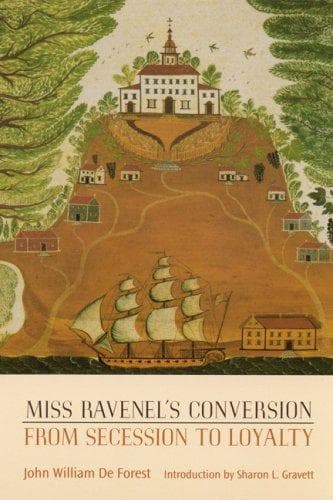
Miss Ravenel's conversion from secession to loyaltyDe Forest, John William
History
Miss Ravenel's conversion from secession to loyalty
De Forest, John William
Historical fiction; United States -- History -- Civil War, 1861-1865 -- Fiction; War stories; Women -- United States -- Fiction
A prospect of flat peace and boundless prosperity is tiresome to the
human eye. Although it is morally agreeable to think about the domestic
happiness and innocence of the Carters, as sketched in a late chapter,
there is danger that the subject might easily prove tiresome to the
reader, and moreover it is difficult to write upon it. I announce
therefore with intellectual satisfaction that our Colonel is summoned to
the trial of bidding good-bye to his wife, and undertaking a journey to
Washington.
It was his own work and for his own interests. He felt the necessity of
adding to his income, and desired the honor and claimed the justice of
promotion. High Authority in the department admitted that the star of a
brigadier was not too high a reward for this brave man, thoroughly
instructed officer, model colonel. High Authority was tired of
gerrymandering seniorities so as to give a superb brigade of three
thousand men to the West Point veteran, Carter, and a skeleton division
of nine hundred men to the ex-major-general of militia, ex-mayor of
Pompoosuc, Brigadier-General John Snooks. Accordingly when the Colonel
applied for a month's leave of absence, with the understood purpose of
sueing for an acknowledgment of his services, High Authority made him
bearer of dispatches to Washington, so that, being on duty, he might pay
his travelling expenses out of the Government pocket. The same mail
which brought him his order informed him that a steamer would sail for
the north on the next day but one. Acting with the rapidity which always
marked his movements when he had once decided on his course, he took the
next morning's train for New Orleans, first pressing his wife for many
times to his breast and kissing away such of her tears as he could stay
to witness. To good angels, and other people capable of appreciating
such things, it would have been a pretty though pathetic spectacle to
see this slender, blonde-haired girl clinging to the strong, bronzed,
richly colored man with the burning black eyes.
"Oh, what shall I do without you?" she moaned. "What shall I do with
myself?"
"My dear little child," he said, "you will do just what you like. If you
choose to stay here and keep house, Captain Colburne will see that you
are cared for. Perhaps it may be best, however, to join your father.
Here are two hundred dollars, all the money that I have except what is
necessary to take me to New Orleans. I shall get a month's pay there.
Don't settle any bills. Tell people that I will attend to them when I
come back.--There. Don't keep me, my dear one. Don't make me lose the
train."
Public-domain text, read in full here on John Shaqi.
Reviews
Reviews
No reviews yet
Be the first to share your thoughts on this work.
Elsewhere in the archive
Join the Discussion
Join the discussion
Sign in to leave a comment or review.
Sign InorCreate an account