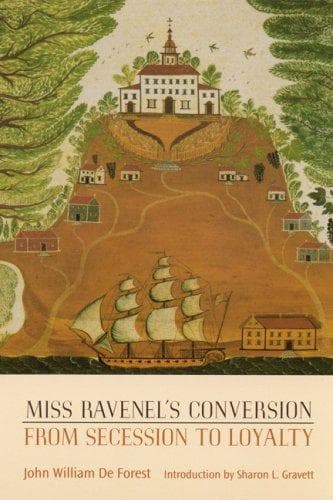
Miss Ravenel's conversion from secession to loyaltyDe Forest, John William
History
Miss Ravenel's conversion from secession to loyalty
De Forest, John William
Historical fiction; United States -- History -- Civil War, 1861-1865 -- Fiction; War stories; Women -- United States -- Fiction
Next morning, in possession of his sober senses, Carter endeavored to
detach himself a little from Mrs. Larue, impelled to this seeming lack
of chivalry by remembrance of his wife, and mistrust of his own power of
self-government. But this prudent course soon appeared to be impossible
for a variety of reasons. In the first place it happened, whether by
chance or through her forethought he did not know, that their
state-rooms opened on the same narrow passage. In the second place, he
was the only acquaintance that Mrs. Larue had on board, and there was
not another lady to take her up, the Creole being a Government
transport, and civilian travel being in those times rare between New
York and New Orleans. Moreover, the other passengers were in his
estimation low, or at least plain people, such as sutlers, speculators,
and rough volunteer officers--so that, if he left her, she was alone,
and could not even venture on deck for a breath of fresh air. At any
rate, that was the way that she chose to put it, although there was not
the least danger that she would be insulted, and although, had Carter
been absent, she would not have failed to strike up a flirtation with
some other representative of my noble sex. Finally, he was obliged to
consider that she was a relative of his wife. Thus before the second day
was over, he found himself under bonds of courtesy to be the constant
attendant of Mrs. Larue. They sat together next the head of the table,
the lady being protected from the ignoble crowd of volunteers by the
Colonel on one side, and the captain of the Creole on the other.
Opposite them were a major and a chaplain, highly respectable persons so
far as one could judge from their conversation, but who never got a
word, rarely a look, from Mrs. Larue or Carter. The captain talked,
first with one party, then with the other, but never with both at once.
He was a polite and considerate man, accustomed to his delicate official
position as a host, and he saw that he would not be thanked for making
the conversation general. Except to him, to Carter, and to the servants,
Mrs. Larue did not speak one word during the first seven days of the
passage. All the volunteer officers admired her nun-like demeanor. Kept
afar off, and with no other woman in sight, they began to worship her,
much as the brigade at Thibodeaux adored that solitary planet of
loveliness, Mrs. Carter. The fact that she was a widow, which crept out
in some inexplicable manner, only heightened the enthusiasm.
"By Heavens!" declared one flustered Captain, "if I only had Colonel
before my name, and a hundred thousand dollars after it, I would rush to
her and say, 'Madame, are you inconsolable? _Could_ I persuade you to
forget the dear departed?'"
Public-domain text, read in full here on John Shaqi.
Reviews
Reviews
No reviews yet
Be the first to share your thoughts on this work.
Elsewhere in the archive
Join the Discussion
Join the discussion
Sign in to leave a comment or review.
Sign InorCreate an account