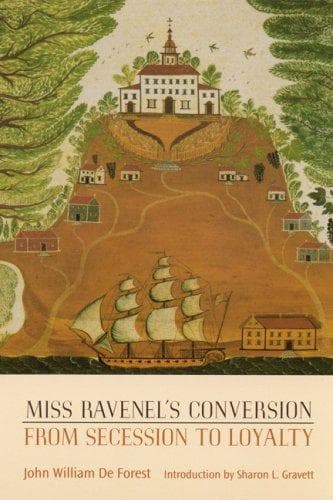
Miss Ravenel's conversion from secession to loyaltyDe Forest, John William
History
Miss Ravenel's conversion from secession to loyalty
De Forest, John William
Historical fiction; United States -- History -- Civil War, 1861-1865 -- Fiction; War stories; Women -- United States -- Fiction
While these gentlemen worshipped her, Carter hoped she would get
sea-sick. This great, brawny, boisterous, domineering, heroic fighter
had just enough moral vitality to know when he was in danger of falling,
and to wish for safety. Those were perilous hours at evening, when the
ship swept steadily through a lulling whisper of waters, when a trail of
foamy phosphorescense, like a transitory Milky Way, followed in pursuit,
when a broad bar of rippling light ran straight out to the setting moon,
when the decks were deserted except by slumberers, and Mrs. Larue
persisted in dallying. The temptation of darkness, the temptation of
solitude, the fever which begins to turn sleepless brains at midnight,
made this her possible hour of coquettish conquest. She varied from
delicately phrased sentimentalities to hoydenish physical impertinences.
He was not permitted for five minutes together to forget that she was a
bodily, as well as a spiritual presence. He was not checked in any
transitory license of speech or gesture. Meantime she quoted fine
rhapsodies from Balzac, and repeated telling situations from Dumas le
Jeune, and commented on both in the interest of the _sainte passion de
l'amour_. Once, after a few moments of silence and revery, she said with
an air of earnest feeling, "Is it not a horrible fate for a
woman--solitude? Do you not pity me? Thirty years old, a widow, and
childless! No one to love; no right to love any one."
She changed into French now, as she frequently did when she was animated
and wished to express herself freely. Such talk as this sounds unnatural
in the language of the Anglo-Saxon, but is not so unbecoming to the
tongue of the Gauls.
"A woman to whom the affections are forbidden, is deprived of the use of
more than half her being. Whatever her possibilities, she is denied all
expansion beyond a certain limit. She may not explore, much less use,
her own heart. It contains chambers of joy which she can only guess of,
and into which she must not enter. There is a nursery of affections
there, but she can only stand with her ear to the door, trying to hear
the sweet prattle within. There is an innermost chapel, with an altar
all set for the communion of love, but no priest to invite her to the
holy banquet. She is capable of a mother's everlasting devotion, but she
scarcely dares suspect it. She is fitted to enter upon the tender
mysteries of wifehood, and yet she is constantly fearing that she shall
never meet a man whom she can love. That is the old maid, horrible name!
The widow is less ashamed, but she is more unhappy. She has been taught
her possibilities, and then suddenly forbidden the use of them."
Had the Colonel been acquainted with Michelet and his fellow rhapsodists
on women, he might have suspected Madame of a certain amount of
plagiarism. But he only thought her amazingly clever, at the same time
that he was unable to answer her in her own style.
Public-domain text, read in full here on John Shaqi.
Reviews
Reviews
No reviews yet
Be the first to share your thoughts on this work.
Elsewhere in the archive
Join the Discussion
Join the discussion
Sign in to leave a comment or review.
Sign InorCreate an account