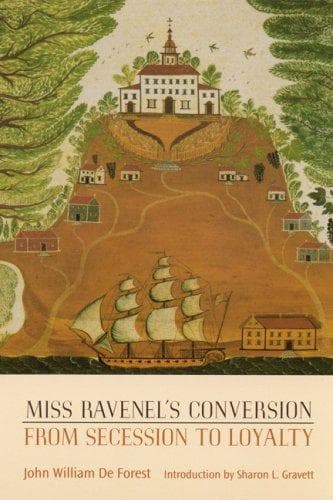
Miss Ravenel's conversion from secession to loyaltyDe Forest, John William
History
Miss Ravenel's conversion from secession to loyalty
De Forest, John William
Historical fiction; United States -- History -- Civil War, 1861-1865 -- Fiction; War stories; Women -- United States -- Fiction
"Why don't you marry?" he asked, striking with Anglo-Saxon practicality
at the root of the matter.
"Satirical question!" responded Madame, putting her face close to his,
doubtless in order to make her smile visible by moonlight. "It is not so
easy to marry in these frightful times. Besides,--shall I avow it?--what
if I cannot marry the man of my choice?"
"That's bad."
"What if he _would_ marry some one else?--Is it not a humiliating
confession?--Do you know what is left to a woman then? Either hidden
love, or spiritual self-murder. Which is the greater of the two crimes?
_Is_ the former a crime? Society says so. But are there not exceptions
to all rules, even moral ones? Love always has this great defence--that
nature prompts it, commands it. As for self-repression, asphyxia of the
heart, Nature never prompts that."
The logical conclusion of all this sentimental sophistry was clear
enough to Carter's intellect, although it did not deceive his
Anglo-Saxon conscience. He understood, briefly and in a matter of fact
way that Madame was quite willing to be his wife's rival. He was not yet
prepared to accept the offer; he only feared and anticipated that he
should be brought to accept it.
Mrs. Larue was a curious study. Her vices and virtues (for she had both)
were all instinctive, without a taint of education or effort. She did
just what she liked to do, unchecked by conscience or by anything but
prudence. She was as corrupt as possible without self-reproach, and as
amiable as possible without self-restraint. Her serenity was at all
times as unrippled as was that of Lillie in her happiest conditions. Her
temper was so sunny, her smile so ready, and her manner so flattering,
that few persons of the male sex could resist liking her. But she was
the detestation of most of her lady acquaintance--who were venomously
jealous of her attractions--or rather seductions--and abhorred her for
the unscrupulous manner in which she put them to use, abusing her in a
way which was enough to make a man rally to her rescue. She really cared
little for that _divin sens du génésiaque_ concerning which she prattled
so freely to her intimates; and therefore she was cool and sure in her
coquetries, at the same time that vanity gave her motive force which
some naughty flirts derive from passion. She took a pride in making
conquests of men, at no matter what personal sacrifice.
Carter saw where he was drifting to, and groaned over it in spirit, and
made resolutions which he broke in half an hour, and rowed desperately
against the tide, and then drifted again.
"A woman in the same house has so many devilish chances at a fellow," he
repeated to himself with a bitter laugh; and indeed he coarsely said as
much to Mrs. Larue, with a desperate hope of angering and alienating
her. She put on a meekly aggrieved air, drew away from him, and
answered, "That is unmanly in you. I did not think you could be so
dishonorable."
Public-domain text, read in full here on John Shaqi.
Reviews
Reviews
No reviews yet
Be the first to share your thoughts on this work.
Elsewhere in the archive
Join the Discussion
Join the discussion
Sign in to leave a comment or review.
Sign InorCreate an account