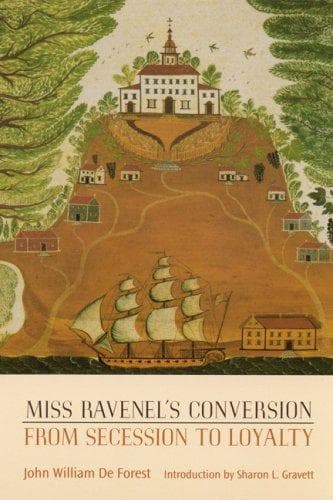
Miss Ravenel's conversion from secession to loyaltyDe Forest, John William
History
Miss Ravenel's conversion from secession to loyalty
De Forest, John William
Historical fiction; United States -- History -- Civil War, 1861-1865 -- Fiction; War stories; Women -- United States -- Fiction
Carter made no answer, not even by a look. He was thinking that his wife
never philosophised concerning her love, never analyzed her sentiments,
and a shock of self-reproach, as startling as the throb of a
heart-complaint, struck him as he called to mind her purity, trust and
affection. It is curious, by the way, that he suffered no remorse on
account of Mrs. Larue. In his opinion she fared no worse than she
deserved, and in fact fared precisely as she desired, only he had not
the nerve to tell her so. When, late one night, on the darkened and
deserted quarter-deck, she cried on his shoulder and whispered, "I am
afraid you don't love me--I have a right to claim your love," he felt no
affection, no gratitude, not even any profound pity. It annoyed him that
she should weep, and thus as it were reproach him, and thus trouble
still further his wretched happiness. He was not hypocrite enough to
say, "I _do_ love you;" he could only kiss her repeatedly, penitently
and in silence. He still had a remnant of a conscience, and a mangled,
sore sense of honor. Nor should it be understood that Mrs. Larue's tears
were entirely hypocritical, although they arose from emotions which were
so trivial as to be somewhat difficult to handle, and so mixed that I
scarcely know how to assort them. In the first place she was not very
well that evening, and was oppressed by the despondency which all human
beings, especially women, suffer from when vitality throbs less
vigorously than usual. Moreover a little emotion of this sort was
desirable, firstly to complete the conquest of Carter by reminding him
how much she had sacrificed for him, and secondly to rehabilitate
herself in her own esteem by proving that she possessed a species of
conscience. No woman likes to believe herself hopelessly corrupt: when
she reaches that point she is subject to moral spasms which make
existence seem a horror; and we perhaps find her floating in the river,
or asphyxiated with charcoal. Therefore let no one be surprised at the
temporary tenderness, similar to compunction, which overcame Mrs. Larue.
Public-domain text, read in full here on John Shaqi.
Reviews
Reviews
No reviews yet
Be the first to share your thoughts on this work.
Elsewhere in the archive
Join the Discussion
Join the discussion
Sign in to leave a comment or review.
Sign InorCreate an account