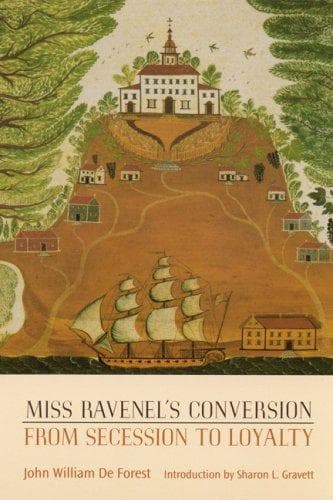
Miss Ravenel's conversion from secession to loyaltyDe Forest, John William
History
Miss Ravenel's conversion from secession to loyalty
De Forest, John William
Historical fiction; United States -- History -- Civil War, 1861-1865 -- Fiction; War stories; Women -- United States -- Fiction
Now that these two had that conscience which makes cowards of us all,
they dropped a portion of the reserve with which they had hitherto kept
their fellow-passengers at a distance. The captain was encouraged to
introduce his two neighbors, the major and chaplain; and Mrs. Larue cast
a few telling glances at the former and discussed theological subjects
with the latter. To one who knew her, and was not shocked by her
masquerades, nothing could be more diverting than the nun-like airs
which she put on _pour achalander le prêtre_. Carter and she laughed
heartily over them in their evening asides. She would have made a
capital actress in the natural comedy school known on the boards of the
Gymnase and at Wallack's, for it was an easy amusement to her to play a
variety of social characters. She had no strong emotions nor profound
principles of action, it is true, but she was sympathetic enough to
divine them, and clever enough to imitate their expression. Her manner
to the chaplain was so religiously respectful as to pull all the strings
of his unconscious vanity, personal and professional, so that he fell an
easy prey to her humbugging, declared that he considered her state of
mind deeply interesting, prayed for her in secret, and hoped to convert
her from the errors of papacy. Indeed her profession of faith was
promising if not finally satisfactory.
"I believe in the holy catholic church," she said. "But I am not
_dogmatique_. I think that others also may have the truth. Our faith,
yours and mine, is at bottom one, indivisible, uncontradictory. It is
only our human weakness which leads us to dispute with each other. We
dispute, not as to the faith, but as to who holds it. This is
uncharitable. It is like quarrelsome children."
The chaplain was charmed to agree with her. He thought her the most
hopefully religious catholic that he had ever met; he also thought her
the wittiest, the most graceful, and on the whole the handsomest. Her
eyes alone were enough to deceive him: they were inexhaustible
greenrooms of sparkling masks and disguises; and he was especially taken
with the Madonnesque gaze which issued from their recesses. He was
bamboozled also by the prim, broad, white collar, like a surplice, which
she put on expressly to attract him; by the demure air of childlike
piety which clothed her like a mantle; by her deference to his opinion;
by her teachable spirit. Perhaps he may also have been pleased with her
plump shoulders and round arms, and he certainly did glance at them
occasionally as their outlines showed through the transparent muslin;
but he said nothing of them in his talks concerning Mrs. Larue with his
room-mate the Major.
Public-domain text, read in full here on John Shaqi.
Reviews
Reviews
No reviews yet
Be the first to share your thoughts on this work.
Elsewhere in the archive
Join the Discussion
Join the discussion
Sign in to leave a comment or review.
Sign InorCreate an account