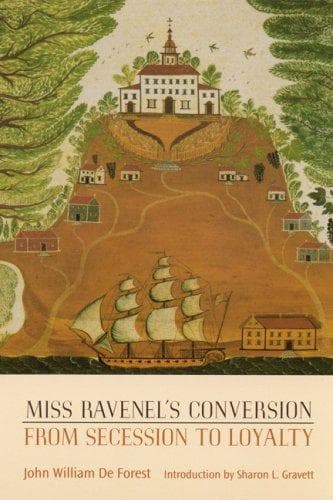
Miss Ravenel's conversion from secession to loyaltyDe Forest, John William
History
Miss Ravenel's conversion from secession to loyalty
De Forest, John William
Historical fiction; United States -- History -- Civil War, 1861-1865 -- Fiction; War stories; Women -- United States -- Fiction
After this speech there was a silence of some minutes. Each of these men
was a wonder to the other; each of them ought to have been a wonder to
himself. The Governor knew that Carter was a roué, a hard drinker,
something of a Dugald Dalgetty; and he could not understand his
professional chivalry, his passion for the honor of the service, his
bitter hatred of cowards. The Colonel knew the Governor's upright moral
character as an individual, and was amazed that such a man could
condescend to what he considered dirty trickery. In one respect, Carter
had the highest moral standpoints. He did wrong to please himself, but
it was under the pressure of overwhelming impulse, and he paid for it in
frank remorse. The other did wrong after calm deliberation, sadly
regretting the alleged necessity, but chloroforming his conscience with
the plea of that necessity. He was at bottom a well-intentioned and
honorable man, but blinded by long confinement in the dark labyrinths of
political intrigue, as the fishes of the Mammoth Cave are eyeless
through the lack of light. He would have shrunk with horror from Carter
had he known of that affair with Madame Larue. At the same time he could
commission a known coward above the heads of heroes, to carry a
Congressional district. And, in order that we may not be too hard upon
him, let us consider his difficulties; let us suppose that he had
elevated the Bayard and thrown the Bardolph overboard. In the first
place all the wire-pullers of his following would have been down upon
him with arguments and appeals, begging him in the name of the party, of
the country, of liberty, not to lose the election. His own candidate in
the doubtful district, an old and intimate friend, would have said, "You
have ruined my chances." All the capitalists and manufacturers who
depended on this candidate to get this or that axe sharpened on the
Congressional grindstone, would have added their outcries to the
lamentation. Thinking of all this, and thinking too of the Copperheads,
and what they would be sure to do if they triumphed, he felt that what
he had decided on was for the best, and that he must do it. Gazaway must
have the lieutenant-colonelcy until the spring election was over; and
then, and not before, he must make way for some honorable man and brave
officer.
"But how can this fellow have such a political influence?" queried the
Colonel. "It ought to be easy enough to expose him in the newspapers,
and smash him."
"The two hundred men or so who vote as he says never read the
newspapers, and wouldn't believe the exposure."
"There is the majority left," observed Carter, after another pause.
"Captain Colburne might have that--if he would take promotion under
Gazaway."
"I have given that to my nephew, Captain Rathbun," said the Governor,
blushing.
He was not ashamed of his political log-rolling with a vulgar coward,
but he was a little discomposed at confessing his very pardonable and
perhaps justifiable nepotism.
Public-domain text, read in full here on John Shaqi.
Reviews
Reviews
No reviews yet
Be the first to share your thoughts on this work.
Elsewhere in the archive
Join the Discussion
Join the discussion
Sign in to leave a comment or review.
Sign InorCreate an account