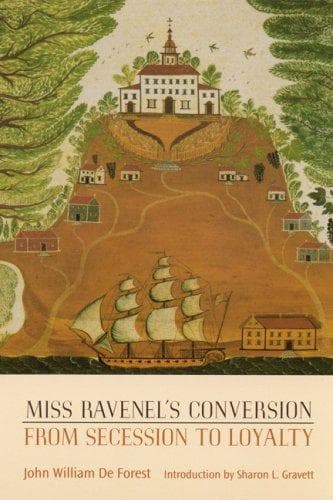
Miss Ravenel's conversion from secession to loyaltyDe Forest, John William
History
Miss Ravenel's conversion from secession to loyalty
De Forest, John William
Historical fiction; United States -- History -- Civil War, 1861-1865 -- Fiction; War stories; Women -- United States -- Fiction
"Captain Rathbun," he pursued hastily, "has been strongly recommended by
all the superior officers of his corps. There is no chance of promotion
in the cavalry, as our State has only furnished three companies. I have
therefore transferred him to the infantry, and I placed him in your
regiment because there were two vacancies."
"Then my recommendation goes for nothing," said Carter, in gloomy
discontent.
"Really, Colonel, I must have some authority in these matters. I am
called commander-in-chief of the forces of the State. I am sorry if it
annoys you. But there will be--I assure you there will soon be--a
vacancy for Captain Colburne."
"But he will have to come in under your nephew, I suppose."
"I suppose so. I don't see how it can be otherwise. But it will be no
disgrace to him, I assure you. He will find Major Rathbun an admirable
officer and a comrade perfectly to his taste. He graduated from the
University only a year after Captain Colburne."
"Excuse me if I leave you for half an hour," observed Carter, without
attempting to conceal his disgust. "I want to step into the smoking-car
and take a segar."
"Certainly," bowed the Governor, and resumed his newspaper. He was used
to such unpleasant interviews as this; and after drawing a tired sigh
over it, he was all tranquillity again. The Colonel was too profoundly
infuriated to return to his companion during the rest of the journey,
much as he wanted his influence to back up his own application for
promotion.
"Horrible shame, by Jove!" he muttered, while chewing rather than
smoking his segar. "I wish the whole thing was in the hands of the War
Department. Damn the States and their rights! I wish, by (this and that)
that we were centralized."
Thus illogically ruminated the West Pointer; not seeing that the good is
not bad merely because it may be abused; not seeing that Centralism is
sure to be more corrupt than Federalism. The reader knows that such
cases as that of Gazaway were not common. They existed, but they were
exceptional; they were sporadic, and not symptomatic. In general the
military nominations of the Governor did honor to his heart and his
head. It was Colburne's accidental misfortune that his State contained
one or two doubtful districts, and that one of them was in the hands,
or was supposed to be in the hands, of his contemptible superior
officer. In almost any other Baratarian regiment the intelligent,
educated, brave and honorable young captain would have been sure of
promotion.
Carter was troubled with a foreboding that his own claims would meet
with as little recognition as those of Colburne. He took plain whiskeys
at nearly every stopping-place, and reached Washington more than half
drunk, but still in low spirits. Sobered and rested by a night's sleep,
he delivered his dispatches, was bowed out by General Halleck, and then
sought out a resident Congressional friend, and held a frank colloquy
with him concerning the attainment of the desired star.
Public-domain text, read in full here on John Shaqi.
Reviews
Reviews
No reviews yet
Be the first to share your thoughts on this work.
Elsewhere in the archive
Join the Discussion
Join the discussion
Sign in to leave a comment or review.
Sign InorCreate an account