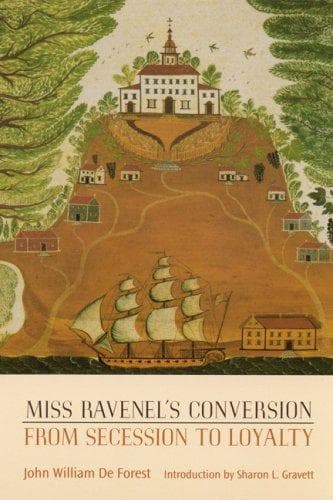
Miss Ravenel's conversion from secession to loyaltyDe Forest, John William
History
Miss Ravenel's conversion from secession to loyalty
De Forest, John William
Historical fiction; United States -- History -- Civil War, 1861-1865 -- Fiction; War stories; Women -- United States -- Fiction
Carter did something in the way of treating, giving game-suppers,
flattering and talking anti-slavery, smiling outwardly the while, but
within full of bitterness. It seemed to him a gross injustice that the
destiny of a man who had fought should be ruled by people who slept in
good beds every night and had never heard a bullet whistle. He thought
that he was demeaning himself by bowing down to members of Congress and
State wire-pullers; but he was driven to it by his professional rage for
promotion, and still more urgently by the necessity of increasing his
income. When he left Washington after the two weeks' stay which was
permitted to him, his nomination to a brigadiership was promised, and he
had strong hopes of obtaining the Senatorial confirmation. At New York
he called on Mrs. Larue. He had not meant to do it when he quitted the
virtuous capital of the nation, but as he approached her he felt drawn
towards her by something stronger than the engine. Moreover, he thought
to himself that she might do something for his promotion if she could
be induced to go to Washington and try the ponderosity of the United
States Senate with that powerful social lever of hers, _la sainte
passion_, etc.
"Why didn't you tell me this before?" she exclaimed. "Why were you not
frank with me, _mon ami_? I would have gone. I would have worked day and
night for you. I would have had such fun! It would have been delicious
to humbug those abolitionist Senators. I would have been the ruin of Mr.
Sumnaire and Mr. Weelsone. There would have been yet more books
dedicated to Sainte Marie Madeleine."
She burst into a laugh at these jolly ideas, and waltzed about the room
with a mimicry of love-making in her eyes and gestures.
"But I can not go alone, you perceive; do you not?" she resumed, sitting
down by his side and laying one hand caressingly on his shoulder. "I
should have no position alone, and there is not the time for me to
create one. Moreover, I have paid for my passage to New Orleans in the
Mississippi."
"Well, we shall be together," said Carter. "That is my boat. But what a
cursed fool I was in not taking you to Washington!"
"Certainly you were, _mon ami_. It is most regrettable. It is
_désespérant_."
As far as these two were concerned, the voyage south was much like the
latter part of the voyage north, except that Carter suffered less from
self-reproach, and was generally in higher spirits. He had not money
enough left to pay for his meals and wine, but he did not hesitate to
borrow a hundred dollars from the widow, and she lent it with her usual
amiability.
"You shall have all I can spare," she said. "I only wish to live and
dress _comme il faut_. You are always welcome to what remains."
Public-domain text, read in full here on John Shaqi.
Reviews
Reviews
No reviews yet
Be the first to share your thoughts on this work.
Elsewhere in the archive
Join the Discussion
Join the discussion
Sign in to leave a comment or review.
Sign InorCreate an account