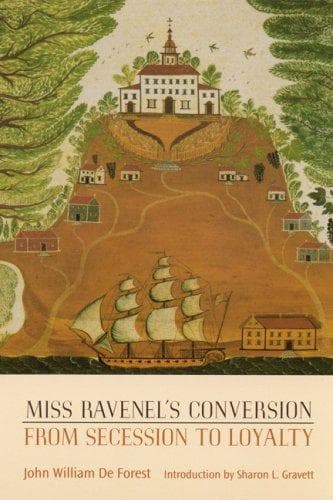
Miss Ravenel's conversion from secession to loyaltyDe Forest, John William
History
Miss Ravenel's conversion from secession to loyalty
De Forest, John William
Historical fiction; United States -- History -- Civil War, 1861-1865 -- Fiction; War stories; Women -- United States -- Fiction
What could the unfortunate man do but be grateful? Mrs. Larue began to
govern him with a mild and insinuating domination; and, strange to say,
her empire was not altogether injurious. She corrected him of a number
of the bearish ways which he had insensibly acquired by life in the
army, and which his wife had not dared to call his attention to,
worshipping him too sincerely. She laughed him out of his swearing, and
scolded him out of most of his drinking. She mended his stockings,
trimmed the frayed ends of his necktie, saw to it that his clothes were
brushed; in short, she greatly improved his personal appearance, which
had grown somewhat shabby under the influences of travelling and
carousing; for the Colonel was one of those innumerable male creatures
who always go to seediness as soon as womankind ceases to care for them.
With him she had no more need of coquetries and sentimental prattle; and
she treated him very much as a wife of five years' standing treats her
husband. She was amiable, pains-taking, petting, slightly exacting,
slightly critical, moderately chatty, moderately loving. They led a
peaceable, domestic sort of life, without much regard to secrecy,
without much terror at the continual danger of discovery. They were old
sinners enough to feel and behave much like innocent people. Carter's
remorse, it must be observed, had arisen entirely from his affection for
his wife, and his shame at having proved unworthy of her affectionate
confidence, and not at all from any sense of doing an injury to Mrs.
Larue, nor from a tenderness of conscience concerning the abstract
question of right and wrong. Consequently, after the first humiliation
of his fall was a little numbed by time, he could be quite comfortable
in spirit.
But his uneasiness awakened at the sight of Lillie, and the pressure of
her joyful embrace. The meeting, affectionate as it seemed on both
sides, gave him a very miserable kind of happiness. He did not turn his
eyes to Mrs. Larue, who stood by with a calm, pleased smile. He was led
away in triumph; he was laid on the best sofa and worshipped; he was a
king, and a god in the eyes of that pure wife; but he was a very
unhappy, and shamefaced deity.
"Oh, what charming letters you wrote!" whispered Lillie. "How good you
were to write so often, and to write such sweet things! They were such a
comfort to me!"
Carter was a little consoled. He _had_ written often and affectionately;
he had tried in that way to make amends for a concealed wrong; and he
was heartily glad to find that he had made her happy.
"Oh, my dear child!" he said. "I am so delighted if I have given you any
pleasure!"
He spoke this with such a sigh, almost a groan, that she looked at him
in wonder and anxiety.
"What is the matter, my darling?" she asked. "What makes you sad? Have
you failed in getting your promotion? Never mind. I will love you to
make up for it. I know, and you know, that you deserve it. We will be
just as happy."
Public-domain text, read in full here on John Shaqi.
Reviews
Reviews
No reviews yet
Be the first to share your thoughts on this work.
Elsewhere in the archive
Join the Discussion
Join the discussion
Sign in to leave a comment or review.
Sign InorCreate an account