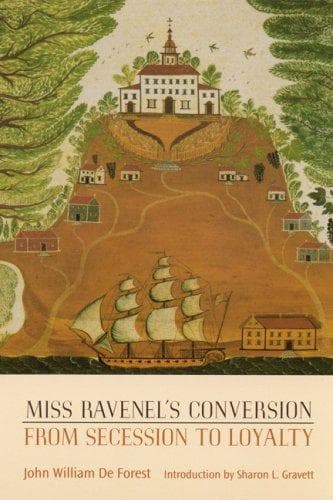
Miss Ravenel's conversion from secession to loyaltyDe Forest, John William
History
Miss Ravenel's conversion from secession to loyalty
De Forest, John William
Historical fiction; United States -- History -- Civil War, 1861-1865 -- Fiction; War stories; Women -- United States -- Fiction
"Perhaps I have not altogether failed," he replied, glad to change the
subject. "I have some hopes yet of getting good news."
"Oh, that will be so delightful! Won't it be nice to be prosperous as
well as happy! I shall be so overjoyed on your account! I shall be too
proud to live."
In his lonely meditations Carter frequently tried himself at the bar of
his strange conscience, and struggled hard to gain a verdict of not
guilty. What could a fellow do, he asked, when a woman would persist in
flinging herself at his head? He honestly thought that most men would
have done as he did; that no one but a religious fanatic could have
resisted so much temptation; and that such resistance would have been
altogether ungentlemanly. To atone for his wrong he was most tender to
his wife; he followed her with attentions, and loaded her with presents.
At the same time that he had a guilt upon his soul which might have
killed her had she discovered it, he would not stint her wardrobe, nor
forget to kiss her every time he went out, nor fail to bring her
bouquets every evening. He has been known to leave his bed at midnight
and walk the street for hours, driving away dogs whose howling prevented
her from sleeping. Deeds like this were his penance, his expiation, his
consolation.
He was now on duty in the city. High Authority, determined to make
amends for the neglect with which this excellent officer was treated,
offered him the best thing which it had now to give, the
chief-quartermastership of the Department of the Gulf. His pay would
thereby be largely increased in consequence of his legal commutations
for rooms and fuel, besides which there was a chance of securing large
extra-official gleanings from such a broad field of labor and
responsibility. But Carter realized little out of his position. He could
keep his accounts of Government property correctly; but except in his
knowledge of returns, and vouchers, and his clerk-like accuracy, he was
not properly speaking a man of business; that is to say, he had no
faculty for making money. He was too professionally honorable to lend
Government funds to speculators for the sake of a share of the profits.
He would not descend to the well-known trickery of getting public
property condemned to auction, and then buying it in for a song to sell
it at an advance. In the case of a single wagon he might do something of
the sort in order to rectify his balances in the item of wagons; or he
might make a certificate of theft in a small affair of trousers or
havresacks which had been lost through negligence, or issued without a
receipt. But to such straits officers were frequently driven by the
responsibility system; he sheltered himself under the plea of necessity;
and did nothing worse. In fact, his position was a temptation without
being a benefit.
Public-domain text, read in full here on John Shaqi.
Reviews
Reviews
No reviews yet
Be the first to share your thoughts on this work.
Elsewhere in the archive
Join the Discussion
Join the discussion
Sign in to leave a comment or review.
Sign InorCreate an account