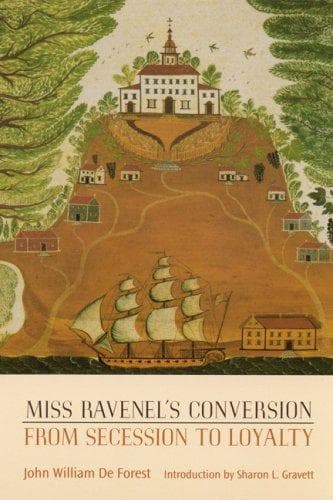
Miss Ravenel's conversion from secession to loyaltyDe Forest, John William
History
Miss Ravenel's conversion from secession to loyalty
De Forest, John William
Historical fiction; United States -- History -- Civil War, 1861-1865 -- Fiction; War stories; Women -- United States -- Fiction
However, the Doctor did in a quiet way put himself on his guard against
Mrs. Larue; and Lillie, observing this, did also in a quiet way feel
quite elated over the condition of things in the family. She was as
happy as she had ever been, or could desire to be. It was a shocking
state of deception; corruption lilied over with decorum and smiling
amiability; whited sepulchres, apples of Sodom, blooming Upas. Carter
saw Mrs. Larue as often as he wanted, and even much oftener, in a
private room, which even his wife did not know of, in rear of his
offices. Closely veiled she slipped in by a back entrance, and
reappeared at the end of ten minutes, or an hour, or perhaps two hours.
It was after such interviews had taken place that his wife welcomed him
with those touching words. "Oh, where have you been? I thought you never
would come."
He would have been glad to break the evil charm, but he was too far gone
to be capable of virtuous effort.
CHAPTER XXIX.
LILLIE REACHES THE APOTHEOSIS OF WOMANHOOD.
Woman is more intimately and irresponsibly a child of Nature than man.
She comes oftener, more completely, and more evidently under the power
of influences which she can neither direct nor resist, and which make
use of her without consulting her inclination. Her part then is passive
obedience and uncomplaining suffering, while through her the ends of
life are accomplished. She has no choice but to accept her beneficent
martyrdom. Like Jesus of Nazareth she agonizes that others may live; but
unlike Him, she is impelled to it by a will higher than her own. At the
same time, a loving spirit is given to her, so that she is consoled in
her own anguish, and does not seriously desire that the cup may pass
from her before she has drunk it to the dregs. She has the patience of
the lower animals and of inanimate nature, ennobled by a heavenly joy of
self-sacrifice, a divine pleasure in suffering for those whom she loves.
She is both lower and higher than man, by instinct rather than by
reason, from necessity rather than from choice.
Public-domain text, read in full here on John Shaqi.
Reviews
Reviews
No reviews yet
Be the first to share your thoughts on this work.
Elsewhere in the archive
Join the Discussion
Join the discussion
Sign in to leave a comment or review.
Sign InorCreate an account