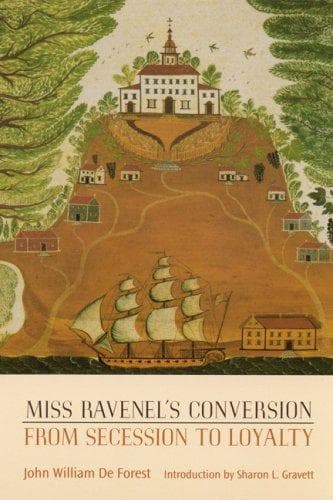
Miss Ravenel's conversion from secession to loyaltyDe Forest, John William
History
Miss Ravenel's conversion from secession to loyalty
De Forest, John William
Historical fiction; United States -- History -- Civil War, 1861-1865 -- Fiction; War stories; Women -- United States -- Fiction
"Men of the world, are they? By Jove! Well; perhaps so; I havn't met
them yet. But if it comes to pointing out men of the world, allow me to
indicate our Louisiana friend, Ravenel. There's a fellow who can do the
universally agreeable. You couldn't tell this evening which he liked
best, Whitewood or me; and I'll be hanged if the same man can like both
of us. When he was talking with the Professor he seemed to be saying to
himself, 'Whitewood is my blue-book;' and when he was talking with me
his whole countenance glowed with an expression which stated that
'Carter is the boy.' What a diplomatist he would make! I like him
immensely. He has a charming daughter too; not beautiful exactly, but
very charming."
Colburne felt an oppression which would not allow him to discuss the
question. At the same time he was not indignant, but only astonished,
perhaps also a little pleased, at the tone of indifference with which
the other spoke of the young lady. His soul was so occupied with this
new train of thought that I doubt whether he heard understandingly the
conversation of his interlocutor for the next few minutes. Suddenly it
struck him that Carter was entirely sober, in body and brain.
"Colonel, wouldn't you like to go on a pic-nic?" he asked abruptly.
"Pic-nic?--political thing? Why, yes; think I ought to like it; help
along our regiment."
"No, no; not political. I'm sorry I gave you such an exalted
expectation; now you'll be disappointed. I mean an affair of young
ladies, beaux, baskets, paper parcels, sandwiches, cold tongue, biscuits
and lemonade."
"Lemonade!" said Carter with a grimace. "Could a fellow smoke?"
"I take that liberty."
"Is Miss Ravenel going?"
"Yes."
"I accept. How do you go?"
"In an omnibus. I will see that you are taken up--say at nine o'clock
to-morrow morning."
CHAPTER IV.
THE DRAMATIC PERSONAGES GO ON A PIC-NIC, AND STUDY THE WAYS OF NEW
BOSTON.
When the Lieutenant-Colonel awoke in the morning he did not feel much
like going on a pic-nic. He had a slight ache in the top of his head, a
huskiness in the throat, a woolliness on the tongue, a feverishness in
the cuticle, and a crawling tremulousness in the muscles, as though the
molecules of his flesh were separately alive and intertwining
themselves. He drowsily called to mind a red-nosed old gentleman whom he
had seen at a bar, trying in vain to gather up his change with shaky
fingers, and at last exclaiming, "Curse the change!" and walking off
hastily in evident mortification.
"Ah, Carter! you will come to that yet," thought the
Lieutenant-Colonel.--"To be sure," he added after a moment, "this
sobering one's self by main strength of will, as I did last night, is an
extra trial, and enough to shake any man's system.--But how about
breakfast and that confounded pic-nic?" was his next reflection.
"Carter, temperance man as you are, you must take a cocktail, or you
won't be able to eat a mouthful this morning."
Public-domain text, read in full here on John Shaqi.
Reviews
Reviews
No reviews yet
Be the first to share your thoughts on this work.
Join the Discussion
Join the discussion
Sign in to leave a comment or review.
Sign InorCreate an account