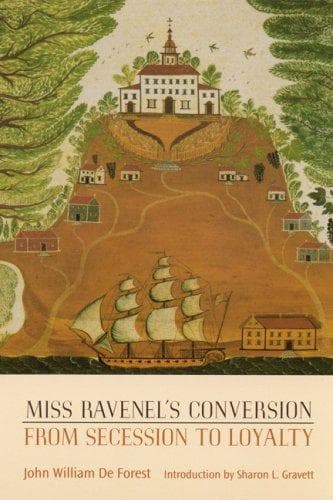
Miss Ravenel's conversion from secession to loyaltyDe Forest, John William
History
Miss Ravenel's conversion from secession to loyalty
De Forest, John William
Historical fiction; United States -- History -- Civil War, 1861-1865 -- Fiction; War stories; Women -- United States -- Fiction
I do not repeat the Colonel's talk. It was not so appropriate as that of
the others to the occasion; for he knew little as yet of the profounder
depths of womanly and infantile nature; his first marriage had been
brief and childless. In fact, Carter was rather a silent man in family
conclaves, unless the conversation turned on some branch of his
profession, or the matters of ordinary existence. He occupied himself
with watching alternately his wife and child; with wrapping up the
former, and occasionally fondling the latter.
"How very warm he feels!--how amazingly he pulls hair!--I believe he
wants to get my head in his mouth," are samples of his observations on
the infant wonder. He felt that the baby was either below him or above
him, he really could not tell which. Of his wife's position he was
certain: she was far higher than his plane of existence: when she took
his hand it was from the heavens.
From Mrs. Larue he was thoroughly detached, and with a joyful sense of
relief, freedom, betterment. They talked very little with each other,
and only on indifferent subjects and in the presence of others. It is
possible that this separation would not have lasted if they had been
thrown together unguarded, as had been the case on board the Creole; but
here, caring for his infant and for the wife who had suffered so much
and so sweetly for his sake, the Colonel felt no puissance of passionate
temptation.
Mrs. Larue had no conscience, no sense of honor; but like many cold
blooded people, she valued herself on her firmness. In an unwonted burst
of enthusiasm she had told him that all must be over between them, and
she meant to make her words good, no matter what he might desire. She
was a little mortified to see how easily he had cut loose from her; but
she knew how to explain it so as not to wound her vanity, nor tempt her
to break her resolution.
"If he did not love his wife now, he would be a brute," she reflected.
"And if he had had the possibilities of a brute in him, I never should
have had a caprice for him. After all, I do not care much for the merely
physical human being. _C'est par le côte morale qu 'on s'empare de moi.
Après tout je suis presque aussi pure dans les sentiments que ma petite
cousine._"
Meanwhile her self-restraint was something of a trial to her. At times
she thought seriously of marrying again, with the idea of putting an end
to these risky intrigues and harassing struggles. Perhaps it was under
this impression that she wrote a letter to Colburne, informing him of
the birth of Ravvie, and sketching some few items of the scene with a
picturesqueness and sympathy that quite touched the young gentleman,
astonished as he was at the frankness of the language.
Public-domain text, read in full here on John Shaqi.
Reviews
Reviews
No reviews yet
Be the first to share your thoughts on this work.
Elsewhere in the archive
Join the Discussion
Join the discussion
Sign in to leave a comment or review.
Sign InorCreate an account