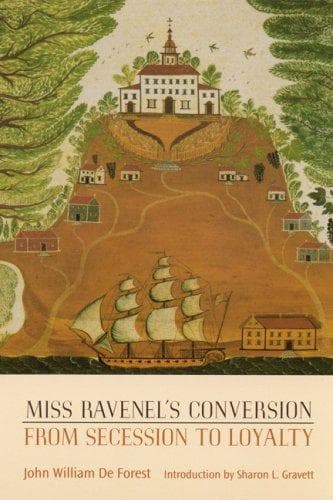
Miss Ravenel's conversion from secession to loyaltyDe Forest, John William
History
Miss Ravenel's conversion from secession to loyalty
De Forest, John William
Historical fiction; United States -- History -- Civil War, 1861-1865 -- Fiction; War stories; Women -- United States -- Fiction
"After all," she concluded, "married life has exquisite pleasures, as
well as terrific possibilities of sorrow. I do not really know whether
to advise a young man like you to take a wife or not. Whether you marry
or remain single you will be sorry. I think that in either state the
pains outweigh the pleasures. It follows that we are not to consider our
own happiness, but to do what we think is for the happiness of others.
Is not this the true secret of life?"
"Is it possible that I have been unjust?" queried Colburne. "Those are
not the teachings of a corrupted nature."
He did not know and could not have conceived the unnatural conscience,
the abnormal ideas of purity and duty, which this woman had created for
her own use and comfort, out of elements that are beyond the ken of most
New Englanders. He was the child of Puritanism, and she of Balzac's
moral philosophy.
CHAPTER XXX.
COLONEL CARTER COMMITS HIS FIRST UNGENTLEMANLY ACTION.
We come now to the times of the famous and unfortunate Red River
expedition. During the winter of 1863-4 New Orleans society, civil as
well as military, was wild with excitement over the great enterprise
which was not only to crush the rebel power in the southwest, but to
open to commerce the immense stores of cotton belonging to the princely
planters of the Red River bottoms. Cotton was gold, foreign exchange,
individual wealth, national solvency. Thousands of men went half mad in
their desire for cotton. Cotton was a contagion, an influenza, a
delirium.
In the height of this excitement a corpulent, baldish, smiling gentleman
of fifty was closeted, not for the first time, with the chief
quartermaster. His thick feet were planted wide apart, his chubby hands
rested on his chubby knees, his broad base completely filled the large
office chair in which he sat, his paunchy torso and fat head leaned
forward in an attitude of eagerness, and his twinkling grey eyes,
encircled by yellowish folds, were fixed earnestly upon the face of
Carter.
"Colonel, you make a great mistake in letting this chance slip," he
said, and then paused to wheeze.
The Colonel said nothing, smoked his twenty cent Havana slowly, and
gazed thoughtfully at the toes of his twenty dollar boots. With his
aristocratic face, his lazy pride of expression, his bran-new citizen's
suit, his boots and his Havana, he looked immensely rich and superbly
indifferent to all pecuniary chances.
"You see, here is a sure thing," continued the oleaginous personage.
"Banks' column will be twenty thousand strong. Steele's will be ten
thousand. There are thirty thousand, without counting Porter's fleet.
The Confederates can't raise twenty thousand to cover the Red River
country, if they go to hell. Besides, there is an understanding. Tit for
tat, you know. Cotton for cash. You see I am as well posted on the
matter as you are, Colonel."
Public-domain text, read in full here on John Shaqi.
Reviews
Reviews
No reviews yet
Be the first to share your thoughts on this work.
Elsewhere in the archive
Join the Discussion
Join the discussion
Sign in to leave a comment or review.
Sign InorCreate an account