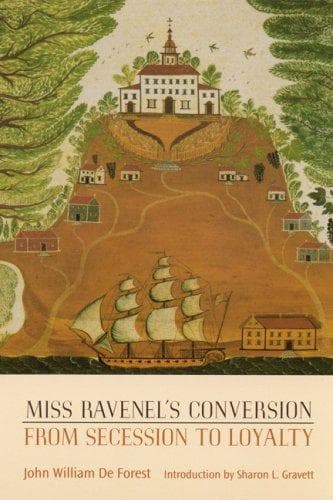
Miss Ravenel's conversion from secession to loyaltyDe Forest, John William
History
Miss Ravenel's conversion from secession to loyalty
De Forest, John William
Historical fiction; United States -- History -- Civil War, 1861-1865 -- Fiction; War stories; Women -- United States -- Fiction
"Mr. Hollister," said Carter, "I hope I shall not offend you if I say
that I know you have suffered heavily by the war."
"I shall certainly not be offended. I am obliged to you for showing the
slightest interest in my affairs."
"You have taken the oath of allegiance--haven't you?"
Mr. Hollister said "Yes," and bowed respectfully, as if saluting the
United States Government.
"It is only fair that you should obtain remuneration for your losses."
The black eyes flashed a little under the iron-gray, bushy eyebrows, but
the sallow face showed no other sign of interest and none of impatience.
"I know of a transaction--an investment--" pursued Carter, "which will
probably enable you to pocket--to realize--perhaps twenty thousand
dollars."
"I should be indebted to you for life. Whatever service I can render in
return will be given with all my heart."
"It requires secrecy. May I ask you to pledge your word?"
"I pledge it, Colonel--my word of honor--as a Louisiana gentleman."
Carter drew a long breath, poured out another dose of brandy, partially
raised it and then set it, down without drinking.
"There are ten river steamboats here," he went on--"ten transports which
are not wanted. I have received a message from headquarters to the
effect that we no longer need our present large force of transports. The
army will not retreat from Grande Ecore. It is sufficiently reinforced
to go to Shreveport. I am empowered to select eight of these transports
for sale--you understand."
"Precisely," bowed Hollister. "If the army advances, of course it does
not need transports."
As to the military information he neither believed nor disbelieved,
knowing well that the Colonel would not honestly tell him anything of
consequence on that score.
"Well, they will be sold," added Carter, after a pause, during which he
vainly tried to imagine some other method of covering his enormous
defalcation. "They will be sold at auction. They will probably bring
next to nothing. I propose that you be present to buy them."
The broker closed his eyes for a moment or two, and when he had opened
them he had made his calculations. He inferred that the United States
Government was not to profit much by the transaction; that, in plain
words, it was to be cheated out of an amount of property more or less
considerable; and, being a Confederate at heart, he had no objection.
"Why not have a private sale?" he asked.
"It is contrary to the Regulations."
"Ah! Then it might be well not to have the auction made too public."
"I suppose so. Perhaps that can be arranged."
Public-domain text, read in full here on John Shaqi.
Reviews
Reviews
No reviews yet
Be the first to share your thoughts on this work.
Elsewhere in the archive
Join the Discussion
Join the discussion
Sign in to leave a comment or review.
Sign InorCreate an account