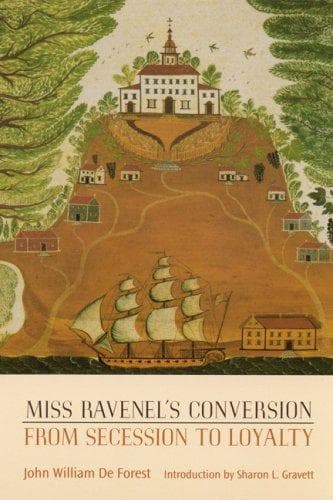
Miss Ravenel's conversion from secession to loyaltyDe Forest, John William
History
Miss Ravenel's conversion from secession to loyalty
De Forest, John William
Historical fiction; United States -- History -- Civil War, 1861-1865 -- Fiction; War stories; Women -- United States -- Fiction
"I can arrange it, Colonel. If I may select the parties to be present,
men of straw, you understand--the auction will wear a sufficient air of
publicity, and will yet be substantially a private sale. All that is
easily enough managed, provided we first understand each other
thoroughly. Listen, if you please. The ten steamboats are worth, we will
say, an average of twenty-five thousand dollars, or two hundred and
fifty thousand for the lot. If I buy them for an average of ten
thousand, which is respectable----"
Here he looked gravely at Carter, and, seeing assent in his eyes,
continued.
"If I buy them at an average of ten thousand, there will remain a
profit--in case of sale--of one hundred and fifty thousand. That is very
well--exceedingly well. Of course I should only demand a moderate
proportion of so large a sum. But there are several other things to be
considered. If I am to pay cash down, it will oblige me to borrow
immensely, and perhaps to realize at a loss by forcing sales of my
stocks. In that case I should want--say a third--of the profit in order
to cover my risk and my losses, as well as my expenses in the way of--to
be plain--hush-money. If I can pay by giving my notes, and moreover can
be made sure of a purchaser before the notes mature, I can afford to
undertake the job for one sixth of the profits, which I estimate to be
twenty-five thousand dollars."
There was a flash of pleasure in Carter's eyes at discovering that the
broker was so moderate in his expectations. There was a similar glitter
in the dark orbs of Hollister at seeing that the Colonel tacitly
accepted his offer, from which he would have been willing to abate a few
thousands rather than lose the job.
"The boats will have to go before an Inspector before they can be sold,"
said the Colonel, after a few moments of reverie, during which he drank
off his brandy.
"I hope he will be amenable to reason," said Hollister. "Perhaps he will
need a couple of thousands or so before he will be able to discover his
line of duty. It may answer if he is merely ignorant of steamboats."
"Of course he is. What can an army officer know about steam engines or
hulls?"
"I will see that he is posted. I will see that he has entirely
satisfactory evidence concerning the worthless nature of the property
from the captains, and engineers, and carpenters. That will require--say
three thousand--possibly twice that. I will advance the money for these
incidental expenses, and you will reimburse me one half when the
transaction is complete."
The Colonel looked up uneasily, and made no reply. He did not want to
make money out of the swindle: curiously enough he still had too much
conscience, too much honor, for that; but he must be sure of enough to
clear off his defalcation.
"Well, we will see about that afterward," compromised Hollister. "I will
pay these expenses and leave the question of reimbursement to you. By
the way, what are the names of the boats? I know some of them."
Public-domain text, read in full here on John Shaqi.
Reviews
Reviews
No reviews yet
Be the first to share your thoughts on this work.
Elsewhere in the archive
Join the Discussion
Join the discussion
Sign in to leave a comment or review.
Sign InorCreate an account