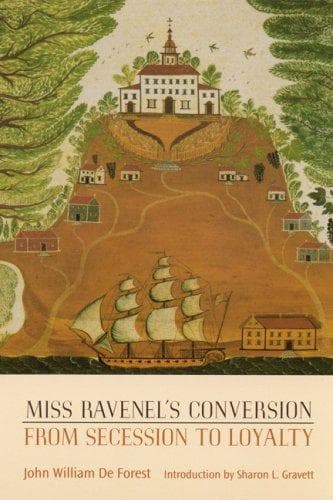
Miss Ravenel's conversion from secession to loyaltyDe Forest, John William
History
Miss Ravenel's conversion from secession to loyalty
De Forest, John William
Historical fiction; United States -- History -- Civil War, 1861-1865 -- Fiction; War stories; Women -- United States -- Fiction
Colonel Carter sent a square balance-sheet to the Quartermaster's
Department at Washington, and paid all his private debts in New Orleans.
But he grew thin, looked anxious, or ostentatiously gay, and resumed to
some extent his habits of drinking. Once he terrified his wife by
remaining out all night, explaining when he came home in the morning
that he had been up the river on pressing business. The truth is that
the Colonel had got himself stone-blind drunk, and had slept himself
sober in a hotel.
CHAPTER XXXI.
A TORTURE WHICH MIGHT HAVE BEEN SPARED.
A week after the conflagration Carter received his commission as
Brigadier-General. His first impression was one of exultation: his
enemies and his adverse fate had been beaten; he was on the road to
distinction; he could wear the silver star. Then came a feeling of
despondency and fear, while he remembered the crime into which he had
been driven, as he thought or tried to think, by the lack of this just
recognition of his services. Oh the bitterness of good fortune, long
desired, which comes too late!
"A month ago this might have saved me," he muttered, and then burst into
curses upon his political opponents, his creditors, himself, all those
who had brought about his ruin.
"My only crime! The only ungentlemanly act of my life!" was another
phrase which dropped from his lips. Doubtless he thought so: many people
of high social position hold a similarly mixed moral creed; they allow
that a gentleman may be given to expensive immoralities, but not to
money-getting ones; that he may indulge in wine, women, and play, but
not in swindling. All over Europe this curious ethical distinction
prevails, and very naturally, for it springs out of the conditions of a
hereditary aristocracy, and makes allowance for the vices to which
wealthy nobles are tempted, but not for vices to which they are not
tempted. A feeble echo of it has traversed the ocean, and influenced
some characters in America both for good and for evil.
Carter was almost astonished at the child-like joy, so contradictory to
his own angry remorse, with which Lillie received the news of his
promotion.
"Oh!--My General!" she said, coloring to her forehead with delight,
after a single glance at the commission which he dropped into her lap.
She rose up and gave him a mock military salute; then sprang at him and
covered his bronzed face and long mustache with kisses.
"I am so happy! They have done you justice at last--a little justice.
Oh, I am so glad and proud! I am going with you to buy the star. You
shall let me choose it."
Then, her mind taking a forward leap of fifteen years, she added, "We
will send Ravvie to West Point, and he shall be a general, too. He is
going to be very intelligent. And brave, also. He isn't in the least
timid."
Carter laughed for the first time since he had received the commission.
Public-domain text, read in full here on John Shaqi.
Reviews
Reviews
No reviews yet
Be the first to share your thoughts on this work.
Elsewhere in the archive
Join the Discussion
Join the discussion
Sign in to leave a comment or review.
Sign InorCreate an account