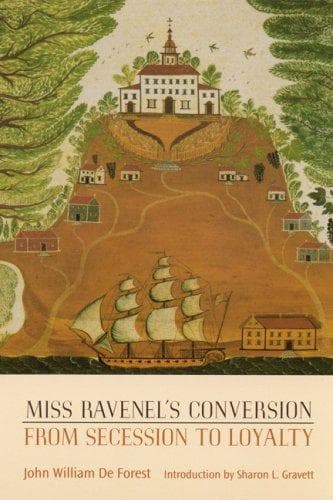
Miss Ravenel's conversion from secession to loyaltyDe Forest, John William
History
Miss Ravenel's conversion from secession to loyalty
De Forest, John William
Historical fiction; United States -- History -- Civil War, 1861-1865 -- Fiction; War stories; Women -- United States -- Fiction
"My dear," said he, "Ravvie will probably become a general long after I
have ceased to be one. I am a volunteer. I am only a general while the
war lasts."
"But the war will last a long time," hopefully replied the monster in
woman's guise, who loved her husband a hundred times as much as she did
her country.
"There is one unpleasant result of this promotion," observed Carter.
"What! You are not going to the field?" asked Lillie, clutching him by
the sleeve. "Oh, don't do that!"
"My little girl, I cannot hold my present position. A Brigadier-General
can't remain quartermaster, not even of a department. I must resign it
and report for duty. Headquarters may order me to the field, and I
certainly ought to go."
"Oh no! It can't be necessary. To think that this should come just when
we were so happy. I wish you hadn't been promoted."
"My darling, you want to make a woman of me," he said, holding her close
to his side. "I must show myself a man, now that my manhood has been
recognized. My honor demands it."
He talked of his honor from long habit; conscious, however, that the
word stung him.
"But don't ask to be sent to the field," pleaded Lillie. "Resign your
place and report for duty, if you must. But please don't ask to be sent
to the field. Promise me that; won't you?"
Looking into his wife's tearful eyes, with his strong and plump hands on
her sloping shoulders, the Colonel promised as she asked him. But that
evening, writing from his office, he sent a communication to the
headquarters of the Department of the Gulf, requesting that he might be
relieved from his quartermastership and assigned to duty with the army
in the field. What else should he do? He had proved himself unfit for
family life, unfit for business; but, by (this and that and the other)
he could command a brigade and he could fight. He would do what he had
done, and could do again, with credit. Besides, if he should win
distinction at Grande Ecore, it might prevent an investigation into that
infernal muddle of cotton and steamboats. A great deal is pardoned by
the public, and even by the War Department, to courage, capacity, and
success.
In a few days he received orders from the General commanding, directing
him to report to the headquarters of the army in the field. He signed
his last quartermaster papers gaily, kissed his wife and child sadly,
shook hands with Ravenel and Mrs. Larue, and took the first boat up the
river.
Public-domain text, read in full here on John Shaqi.
Reviews
Reviews
No reviews yet
Be the first to share your thoughts on this work.
Elsewhere in the archive
Join the Discussion
Join the discussion
Sign in to leave a comment or review.
Sign InorCreate an account