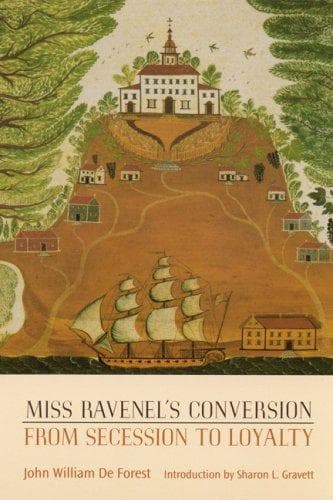
Miss Ravenel's conversion from secession to loyaltyDe Forest, John William
History
Miss Ravenel's conversion from secession to loyalty
De Forest, John William
Historical fiction; United States -- History -- Civil War, 1861-1865 -- Fiction; War stories; Women -- United States -- Fiction
After circulating through the city to pick up the various invited ones,
the omnibus was joined by a second omnibus and two or three family
rockaways. The little fleet of vehicles then sailed into the country,
and at the end of an hour's voyage came to anchor under the lee of a
wooded cliff called the Eagle's Nest, which was the projected site of
the pic-nic. Up the long slope which formed the back of the cliff, a
number of baskets and demijohns were carried by the youthful beaux of
the party with a child-like zeal which older gallants might not have
exhibited. Carter's weighty hamper was taken care of by a couple of
juniors, who jumped to the task on learning that it belonged to a United
States army officer. He offered repeatedly to relieve them, but they
would not suffer it. In a roundabout and inarticulate manner they were
exhibiting the fervent patriotism of the time, as well as that perpetual
worship which young men pay to their superiors in age and knowledge of
the world. And oh! how was virtue rewarded when the basket was opened
and its contents displayed! It was not for the roast chicken that the
two frolicsome juniors cared: the companion baskets around were crammed
with edibles of all manner of flesh and fowl; it was the sight of six
bottles of champagne which made their eyes rejoice. But with a holy
horror equal to their wicked joy did all the matrons of the party, and
indeed more than half of the younger people, stare. Carter's champagne
was the only spirit of a vinous or ardent nature present. And when he
produced two bunches of segars from his pockets and proceeded to
distribute them, the moral excitation reached its height. Immediately
there were opposing partisans in the pic-nic: those who meant to take a
glass of champagne and smoke a segar, if it were only for the wicked fun
of the thing; and those who meant, not only that they would not smoke
nor drink themselves, but that nobody else should. These last formed
little groups and discussed the affair with conscientious bitterness.
But what to do? The atrocity puzzled them by its very novelty. The
memory of woman did not go back to the time when an aristocratic New
Boston pic-nic had been so desecrated. I say the memory of _woman_
advisedly and upon arithmetical calculation; for in this party the age
of the males averaged at least five years less than that of the females.
"Why don't you stop it, Mrs. Whitewood?" said the maiden of thirty-five,
with girlish enthusiasm. "You are the oldest person here." (Mrs.
Whitewood did not look particularly flattered by this statement.) "You
have a perfect right to order anything." (Mrs. Whitewood looked as if
she would like to order the young lady to let her alone.) "If I were
you, I would step out there and say, Gentlemen, this must be stopped."
Public-domain text, read in full here on John Shaqi.
Reviews
Reviews
No reviews yet
Be the first to share your thoughts on this work.
Join the Discussion
Join the discussion
Sign in to leave a comment or review.
Sign InorCreate an account