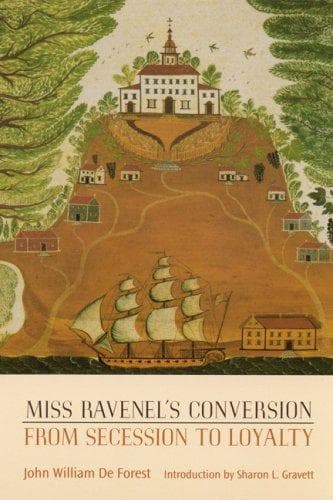
Miss Ravenel's conversion from secession to loyaltyDe Forest, John William
History
Miss Ravenel's conversion from secession to loyalty
De Forest, John William
Historical fiction; United States -- History -- Civil War, 1861-1865 -- Fiction; War stories; Women -- United States -- Fiction
"He did!" responds Miss Ravenel, all interest. "What did that mean? Why
didn't you ask him to repeat it?"
"Because, my dear, he wasn't talking to me; he was talking to Mrs.
Smith."
Here Miss Ravenel perceives that her habitual curiosity is being made
fun of, and replies, "Papa, you ought to be ashamed of yourself."
"My child, you _must_ give me some chance to write," retorts the Doctor;
"or else you must learn to sit a little in your own room. Of course I
prefer to have you here, but I do demand that you accord me some
infinitesimal degree of consideration."
Father and daughter used to have many conversations not very dissimilar
to the above. It was a constant prattle when they were together, unless
the Doctor raised the standard of revolt and refused to talk in order
that he might work. Ever since Lillie's earliest recollection they had
been on these same terms of sociability, companionship, almost equality.
The intimacy and democracy of the relation arose partly from the
Doctor's extreme fondness for children and young people, and partly from
the fact that he had lost his wife early, so that in his household life
he had for years depended for sympathy upon his daughter.
Twice or thrice every morning the Doctor was obliged to remonstrate
against Lillie's talkativeness, something after the manner of an
affectionate old cat who allows her pussy to jump on her back and bite
her ears for a half hour together, but finally imposes quiet by a
velvety and harmless cuffing. Occasionally he avenged himself for her
untimely demands on his attention by reading to her what he considered a
successful passage of the article which he might then be composing. In
this, however, he had not the least intention of punishment, but
supposed that he was conferring a pleasure. It was an essential element
of this genial, social, sympathetic nature to believe that whatever
interested him would necessarily interest those whom he loved and even
those with whom he simply came in contact. When Lillie offered
corrections on his style, which happened frequently, he rarely hesitated
to accept them. Vanity he had none, or at any rate displayed none,
except on two subjects, his daughter and his scientific fame. As a proof
of this last he gloried in an extensive correspondence with European
_savants_, and made Lillie read every one of those queer-shaped letters,
written on semi-transparent paper and with foreign stamps and postmarks
on their envelopes, which reached him from across the Atlantic. Although
medicine was his profession and had provided him with bread, he had
latterly fallen in love with mineralogy, and in his vacation wanderings
though that mountainous belt which runs from the Carolinas westward to
Arkansas and Missouri he had discovered some new species which were
eagerly sought for by the directors of celebrated European collections.
Great was his delight at receiving in New Boston a weighty box of
Public-domain text, read in full here on John Shaqi.
Reviews
Reviews
No reviews yet
Be the first to share your thoughts on this work.
Join the Discussion
Join the discussion
Sign in to leave a comment or review.
Sign InorCreate an account